
If you ask ten JEE aspirants what scares them most about the Maths paper, most won’t say “the difficulty level.” They’ll say “I don’t know where to start.” With 25 chapters spread across Class 11 and Class 12, the JEE Main Maths syllabus and weightage can feel like an ocean — and most students end up swimming in every direction instead of swimming toward the shore.
Here’s the good news: Maths is actually the most predictable and most scoring subject in JEE Main, provided you know which chapters pull the most weight. This guide breaks down the complete JEE Main 2027 Maths syllabus, chapter-wise weightage based on past exam trends, and a preparation strategy that tells you exactly where to put your energy — and where not to waste it.
Why Maths Deserves Special Attention in JEE Main 2027
Unlike Physics or Chemistry, where a formula either works or doesn’t, Maths rewards pattern recognition. Once you’ve solved enough problems from a chapter, similar questions start looking familiar — even when NTA changes the numbers or wraps the concept differently. Students who consistently score well in Maths usually don’t know more than everyone else. They just know their high-weightage chapters cold and don’t waste time on topics that rarely show up.
That’s the entire philosophy behind understanding the JEE Main Maths syllabus and weightage: study smart before you study hard.
JEE Main 2027 Maths Syllabus: The Big Picture
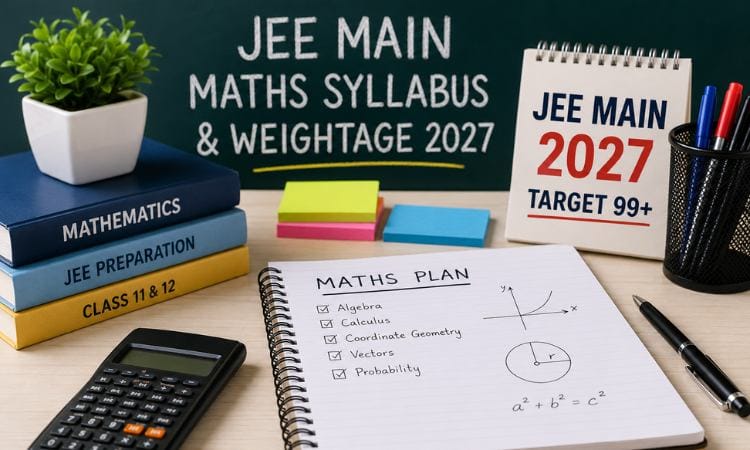
The JEE Main Mathematics syllabus is prescribed by NTA and closely follows the NCERT curriculum for Class 11 and Class 12. It is organized into 14 broad units covering roughly 25 chapters, grouped into these major areas:
- Algebra – Sets, Complex Numbers, Quadratic Equations, Matrices & Determinants, Permutations & Combinations, Binomial Theorem, Sequences & Series
- Calculus – Limits, Continuity & Differentiability, Differentiation, Application of Derivatives, Integration, Differential Equations
- Coordinate Geometry – Straight Lines, Circles, Conic Sections (Parabola, Ellipse, Hyperbola)
- Vectors & 3D Geometry
- Statistics & Probability
- Trigonometry
- Mathematical Reasoning
The paper carries 100 marks in Maths out of the total 300, with 20 MCQs and 5 numerical value questions in the section. Since NTA now applies negative marking to numerical questions as well, guessing blindly is not a safe option — accuracy matters as much as speed.
JEE Main Maths Chapter-wise Weightage 2027 (Based on Past-Year Trends)
NTA doesn’t officially publish weightage percentages—but analysing the last several years of question papers gives a fairly consistent pattern. Use this table for planning, not as a guarantee.
| Chapter/Topic | Weightage Trend | Priority |
|---|---|---|
| Coordinate Geometry (Straight Lines, Circles, Conics) | Very High | Must Master |
| Integration, Differential Equations & Limits (Calculus) | Very High | Must Master |
| Matrices, Determinants & Complex Numbers | High | Must Master |
| Vectors & 3D Geometry | High | High Priority |
| Application of Derivatives & Differentiability | High | High Priority |
| Sequences & Series | Medium | High Priority |
| Probability & Statistics | Medium | High Return, Low Effort |
| Permutations, Combinations & Binomial Theorem | Medium | High Priority |
| Trigonometry (Equations & Identities) | Low-Medium | Steady Scorer |
| Sets, Relations & Mathematical Reasoning | Low | Quick Revision Only |
Based on this trend, Calculus, Algebra, and Coordinate Geometry together tend to make up 60–70% of the Maths paper in most recent years. Master these three areas well, and you’re already covering the majority of your potential score. This is where the high-weightage chapters worth prioritizing first really come into focus.
The One Chapter Most Students Underrate: Probability
Here’s a point most guides miss. Probability isn’t just “medium weightage” — it’s one of the best return-on-effort chapters in the entire syllabus. Most Probability questions in JEE Main are direct applications of conditional probability or Bayes’ theorem, without the layered complexity you see in Calculus or Coordinate Geometry. A focused, dedicated effort on this single chapter tends to pay off faster than the same hours spent on a harder topic like Conic Sections — simply because the question patterns repeat more predictably.
This is exactly the kind of “smart shortcut” that separates students who study more from students who study smarter — chapter selection matters as much as effort.
Class 11 vs Class 12 Weightage: Where Should You Focus More?
A common myth is that JEE Main Maths is “mostly Class 12.” In reality, the split is fairly close, with Class 12 Maths topics like Calculus and Probability tending to carry slightly more weight overall — but Class 11 chapters like Complex Numbers, Sequences & Series, and Conic Sections are just as exam-critical and often easier to master early. Waiting until Class 12 to revisit Class 11 chapters is one of the biggest time-losses students make. Strong Class 11 foundations directly translate into faster Class 12 Calculus, since concepts like limits and functions build directly on earlier algebra.
A Realistic Chapter-Priority Study Plan
Instead of studying chapters in syllabus order, prioritize by weightage and difficulty:
- Foundation Phase (High-weightage, easier chapters first): Quadratic Equations, Sequences & Series, Straight Lines, Probability
- Core-Building Phase (High-weightage, harder chapters): Integration, Differentiation, Matrices & Determinants, Conic Sections
- Advanced Phase (Speed + accuracy chapters): Vectors & 3D Geometry, Differential Equations, Application of Derivatives
- Revision Phase (Low-weightage, fast-revision chapters): Trigonometry, Sets & Relations, Mathematical Reasoning
Spend roughly 60% of your prep time on high-priority chapters, 30% on medium-priority ones, and the remaining 10% on quick revision topics. This ratio protects your score without leaving any part of the syllabus untouched — because JEE Main can and does surprise students with a question from a “low-weightage” chapter.
Also Read: Class 12 Maths Board Exam 2027: 90-Day Study Plan
How to Actually Use This Weightage Data
A weightage table only helps if it becomes part of your daily routine, not something you glance at once and forget:
- After finishing any chapter, immediately solve 5–10 previous-year questions from that exact topic to check if your understanding matches the actual exam level.
- Keep a single running formula sheet for Coordinate Geometry and Trigonometry instead of re-deriving formulas every time — this alone saves significant time in the exam.
- Attempt Algebra and Probability questions first in the actual exam since they’re usually quicker to solve, save Calculus for the middle stretch, and leave complex Coordinate Geometry numericals for the end.
- Track your accuracy chapter-wise, not just your overall score. For example, a student doing well in Algebra but struggling in Calculus needs a very different study plan than one performing evenly across both — the same overall percentage can hide very different gaps.
Why Guided Learning Beats Self-Study for High-Weightage Chapters
Chapters like Integration, 3D Geometry, and Probability aren’t just about knowing the formula — they’re about recognizing which method to apply within seconds under exam pressure. This pattern-recognition skill is exactly what a structured, one-on-one approach builds far faster than solo YouTube-hopping or scattered practice.
At Mathematics Home Tutor, Shamsher Sir’s teaching approach is built around this exact weightage-first philosophy — strengthening high-scoring chapters early, building speed through targeted previous-year-question practice, and closing conceptual gaps before they turn into exam-day panic. If you’re preparing for JEE Main 2027 and want a structured, chapter-prioritized study plan instead of guesswork, book a free demo class and get a personalized weightage-based roadmap for your preparation.
Frequently Asked Questions
Which chapter has the highest weightage in JEE Main Maths? Based on past-year trends, Coordinate Geometry and Calculus (especially Integration and Limits) tend to carry the highest weightage, together contributing a large share of the paper’s total marks. This can vary slightly from session to session.
Is JEE Main Maths syllabus the same as Class 11 and 12 NCERT? Yes, largely. The JEE Main Maths syllabus closely follows the NCERT curriculum, though it includes additional depth and application-based problem types not always covered in board exam questions.
How many chapters are there in JEE Main Maths? The syllabus spans roughly 25 chapters organized into 14 broad units, covering Algebra, Calculus, Coordinate Geometry, Vectors, 3D Geometry, Probability, and Trigonometry.
Can I score well in JEE Main Maths by only studying high-weightage chapters? It’s risky. High-weightage chapters should get the majority of your time, but skipping low-weightage chapters entirely can cost you easy marks, since NTA sets a different paper pattern every session.
Is Probability an easy chapter for JEE Main? Yes — most Probability questions test direct application of standard formulas, making it one of the highest return-on-effort chapters in the entire syllabus.
Disclaimer: NTA has not released the official JEE Main 2027 syllabus and weightage document at the time of publishing. The chapter-wise weightage above is based on trend analysis of previous years’ JEE Main papers and should be used for revision planning. Please cross-check the final syllabus once NTA releases the official 2027 information bulletin.