Trigonometry can feel confusing at first. There are different ratios, identities, standard angles, and formulas, and it is easy to mix them up while preparing for an exam.
But the good thing is that you do not need to memorize every formula separately.
Most trigonometry formulas for Class 10 and 11 are connected to a few basic concepts. Once you understand those connections, remembering and applying the formulas becomes much easier.
In this guide, we have collected the important trigonometry formulas for Class 10 and Class 11 in one place. You will also find simple tricks to remember them and understand where they are used.
By the end of this guide, you will have:
- The important trigonometric ratios and formulas
- Standard angle values from 0° to 90°
- Important trigonometric identities
- Complementary angle formulas
- Easy tricks to remember important formulas
- A quick revision section for exam preparation
Let’s start with the basics.
What Is Trigonometry, Really?
Trigonometry sounds like a big word, but it’s simple. It’s just about a right-angled triangle — its angles and its sides, and how they connect. That’s it. One triangle.
Every formula in this chapter comes from that same triangle. Once you understand this, the formulas won’t feel random anymore.
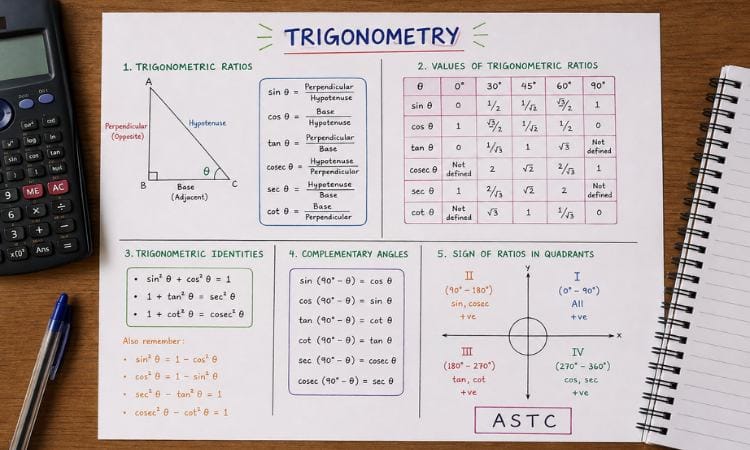
In a right-angled triangle, looking from angle θ (theta), the three sides are:
- Hypotenuse – the longest side, opposite the right angle
- Opposite side (Perpendicular) – the side in front of angle θ
- Adjacent side (Base) – the side next to angle θ
Every trigonometry formula you will ever use comes from comparing these three sides.
Class 10 Trigonometry Formulas
1. The Six Trigonometric Ratios
| Ratio | Formula | Reciprocal Of |
|---|---|---|
| sin θ | Opposite / Hypotenuse | cosec θ |
| cos θ | Adjacent / Hypotenuse | sec θ |
| tan θ | Opposite / Adjacent | cot θ |
| cosec θ | Hypotenuse / Opposite | sin θ |
| sec θ | Hypotenuse / Adjacent | cos θ |
| cot θ | Adjacent / Opposite | tan θ |
A few simple relationships to remember:
- tan θ = sin θ / cos θ
- cot θ = cos θ / sin θ
- sin θ × cosec θ = 1
- cos θ × sec θ = 1
- tan θ × cot θ = 1
2. Trigonometric Ratios of Standard Angles (0°, 30°, 45°, 60°, 90°)
This table is asked in almost every Class 10 board paper. Learn it by heart — it will save you a lot of time.
| Angle → | 0° | 30° | 45° | 60° | 90° |
|---|---|---|---|---|---|
| sin θ | 0 | 1/2 | 1/√2 | √3/2 | 1 |
| cos θ | 1 | √3/2 | 1/√2 | 1/2 | 0 |
| tan θ | 0 | 1/√3 | 1 | √3 | Not defined |
| cosec θ | Not defined | 2 | √2 | 2/√3 | 1 |
| sec θ | 1 | 2/√3 | √2 | 2 | Not defined |
| cot θ | Not defined | √3 | 1 | 1/√3 | 0 |
A simple trick to remember this: Write the numbers 0, 1, 2, 3, 4 under a square root sign and divide each by 2. This gives you sin 0° to sin 90° in order: √0/2, √1/2, √2/2, √3/2, √4/2 = 0, 1/2, 1/√2, √3/2, 1
For cos θ, just write the same values in reverse order. Once you know sin and cos, tan = sin/cos gives you the rest automatically.
3. Trigonometric Identities (Class 10)
These three identities come directly from the Pythagoras theorem. They are asked very often in board exams, so learn them well:
- sin²θ + cos²θ = 1
- 1 + tan²θ = sec²θ
- 1 + cot²θ = cosec²θ
Other useful forms of the same identities (these often appear in tricky exam questions):
- sin²θ = 1 − cos²θ
- cos²θ = 1 − sin²θ
- sec²θ − tan²θ = 1
- cosec²θ − cot²θ = 1
4. Complementary Angle Formulas
When two angles add up to 90°, they are called complementary angles. These formulas help you switch between them:
- sin (90° − θ) = cos θ
- cos (90° − θ) = sin θ
- tan (90° − θ) = cot θ
- cot (90° − θ) = tan θ
- sec (90° − θ) = cosec θ
- cosec (90° − θ) = sec θ
Class 11 Trigonometry Formulas (Building on Class 10)
Don’t worry — Class 11 does not throw away what you learned in Class 10. It simply takes those same ideas further, to all angles (not just 0°–90°), and adds new formulas for combining two angles together. This is also where JEE-level Trigonometry begins.
5. Sign of Trigonometric Ratios in Different Quadrants
| Quadrant | Angle Range | Positive Ratios |
|---|---|---|
| I | 0° – 90° | All (sin, cos, tan) |
| II | 90° – 180° | sin, cosec |
| III | 180° – 270° | tan, cot |
| IV | 270° – 360° | cos, sec |
Easy trick to remember: “Add Sugar To Coffee” — this stands for All, Sin, Tan, Cos, which are positive in Quadrants I, II, III, and IV.
6. Sum and Difference Formulas
- sin (A + B) = sin A cos B + cos A sin B
- sin (A − B) = sin A cos B − cos A sin B
- cos (A + B) = cos A cos B − sin A sin B
- cos (A − B) = cos A cos B + sin A sin B
- tan (A + B) = (tan A + tan B) / (1 − tan A tan B)
- tan (A − B) = (tan A − tan B) / (1 + tan A tan B)
7. Double Angle Formulas
- sin 2A = 2 sin A cos A
- cos 2A = cos²A − sin²A = 2cos²A − 1 = 1 − 2sin²A
- tan 2A = 2 tan A / (1 − tan²A)
8. Half Angle Formulas
- sin (A/2) = ±√[(1 − cos A) / 2]
- cos (A/2) = ±√[(1 + cos A) / 2]
- tan (A/2) = ±√[(1 − cos A) / (1 + cos A)]
9. Sum-to-Product Formulas
- sin A + sin B = 2 sin[(A+B)/2] cos[(A−B)/2]
- sin A − sin B = 2 cos[(A+B)/2] sin[(A−B)/2]
- cos A + cos B = 2 cos[(A+B)/2] cos[(A−B)/2]
- cos A − cos B = −2 sin[(A+B)/2] sin[(A−B)/2]
10. Product-to-Sum Formulas
- 2 sin A cos B = sin(A+B) + sin(A−B)
- 2 cos A sin B = sin(A+B) − sin(A−B)
- 2 cos A cos B = cos(A+B) + cos(A−B)
- 2 sin A sin B = cos(A−B) − cos(A+B)
Download the Complete Formula Sheet (Free PDF)
Revising all these formulas from a webpage right before an exam isn’t ideal. That’s why we’ve put every formula on this page into one clean, print-ready PDF — perfect for quick revision, printing, or keeping saved on your phone.
Formula Chart for Quick Revision (5 Minutes Before Your Exam)
If you’re revising the night before an exam and don’t have time for everything, just focus on these. They cover about 80% of what actually gets asked:
- sin²θ + cos²θ = 1
- The 0°–90° standard angle table
- Complementary angle rules
- sin(A±B) and cos(A±B)
- sin 2A, cos 2A, tan 2A
Once you understand how these connect to each other, you can usually work out the rest on your own — which is much safer than trying to memorize everything without understanding it.
3 Mistakes Almost Every Student Makes At Least Once
After teaching for more than 20 years, Shamsher Sir has noticed the same three mistakes happening again and again — different students, different years, but the same errors. If you’ve made any of these, don’t worry, it’s very common. Here’s how to fix them.
1. Mixing up sin(90°−θ) with sin(θ−90°). These look almost the same, which is exactly why they’re confusing. The first one equals cos θ. The second one equals −cos θ. Just one small sign change, and you lose marks in a board exam for a “correct method, wrong answer” situation.
2. Writing sin θ² when you actually mean sin²θ. It looks like a small typo, but the meaning changes completely. sin²θ means “square the value of sin θ.” But sin θ² actually means “find the sine of theta-squared” — a totally different calculation. Once someone points this out, most students stop making this mistake for good.
3. Assuming tan θ and cot θ always have a value. tan 90° is not zero — it is simply not defined. Same with cot 0°. This one often catches students off guard in MCQs, where the “easy” answer turns out to be wrong.
These are not big conceptual problems. They’re small exam-pressure mistakes — and they go away once you’ve practiced enough to stop overthinking during the exam.
Why Understanding Trigonometry Is Better Than Just Memorising It
Trigonometry may look like a chapter with dozens of formulas, but many of those formulas are connected.
For example, the double-angle formula comes from the sum formula:
sin 2A = sin(A + A)
Similarly, several trigonometric identities can be derived from:
sin²θ + cos²θ = 1
This means you don’t always need to remember every formula as an isolated piece of information.
Understanding the connection between formulas makes it easier to recall them when you are solving a question.
This becomes even more important in Class 11 and JEE preparation, where trigonometry is used with other topics such as Calculus, Coordinate Geometry and Algebra.
For students who find the chapter difficult, one-on-one guidance can also help identify whether the problem is with the basic ratios, identities, calculation, or application of formulas.
Final Takeaway
You don’t need to be afraid of a long list of trigonometry formulas for Class 10 and 11.
Start with the basics:
Six ratios → Standard angles → Identities → Complementary angles → Sum and difference → Double angle → Half angle
Once these concepts are connected, the chapter becomes much easier to revise and apply.
The goal should not be to remember every formula mechanically. Try to understand why the formula works and when to use it.
With regular practice, trigonometry can become one of the most scoring parts of your mathematics preparation.
If you want personalised help with Trigonometry, Class 10/11 Mathematics, or IIT-JEE preparation, you can connect with Shamsher Sir for a free demo class.
Frequently Asked Questions
Q1. How many trigonometry formulas are there for Class 10?
Class 10 has around 15–20 main formulas: the six ratios, the standard angle table, three Pythagoras-based identities, and six complementary angle formulas.
Q2. What is the easiest way to remember trigonometry formulas?
Don’t try to memorize each one separately. First learn the six ratios well. Then learn the standard angle table using the square-root trick shown above. Once you understand these, you’ll see that most other formulas—like double angle and half angle—are just the sum formula used in a different way.
Q3. Is Class 11 Trigonometry harder than Class 10?
Not really harder — just more detailed. Class 11 takes the same Class 10 ideas and applies them to all four quadrants, plus adds formulas for combining angles. If your Class 10 basics are strong, Class 11 will feel much easier.
Q4. Which trigonometry formulas are most important for board exams?
The standard angle table, the three Pythagoras-based identities, and the complementary angle formulas are asked most often in CBSE and ICSE papers.
Q5. Are Class 10 & 11 Trigonometry formulas needed for JEE?
Yes, definitely. JEE Main and Advanced use Class 11 Trigonometry a lot—especially the sum-difference, double-angle, and product-to-sum formulas, which come up again and again in Calculus and Coordinate Geometry questions.