


Every parent knows the moment. The report card comes home, the maths marks are low again, and your child mumbles, “I just don’t get it.” Finding a maths tutor for a weak student is a different job from finding one for a topper. A struggling child needs patience, a proper diagnosis, and someone who rebuilds confidence before chasing marks.
This guide explains the process the way I would explain it to a parent sitting across from me, for Classes 9 to 12.
First, Understand Why Your Child Is Struggling
Most parents hire a tutor before they know what the problem is. That’s like buying medicine without knowing the illness.
“Weak in maths” usually means one of these:
- Old gaps. Fractions, ratios, or basic algebra from Class 7 or 8 were never fully understood, so Class 10 trigonometry feels impossible.
- Rote learning. The child memorises steps. The moment a question is twisted, everything falls apart.
- Fear and low confidence. After a few bad tests, the child decides “maths is not for me” and stops trying.
- Careless mistakes. The concepts are fine, but calculation errors and poor time management eat up marks.
Sit with your child for ten minutes. Give them two or three questions from earlier chapters and watch where they get stuck. You’ll learn more from that than from any test result, and a good tutor will want to hear what you noticed.
What to Look for in a Maths Tutor for a Weak Student
A big degree or a famous name doesn’t make someone the right teacher for a struggling child. These things do.
They start from the gap, not the syllabus. If your child is in Class 9 but weak in Class 7 basics, a good tutor goes back and fixes those first. Rushing through the current chapter only builds a taller house on a shaky floor.
They explain in more than one way. If the first explanation doesn’t land, they try a diagram, a real-life example, or a simpler step. They don’t repeat the same sentence louder.
They make the child do the work. In a demo class, notice who is talking. If the tutor does everything while the student nods, nothing is being learned. Your child should be solving, explaining, and even getting things wrong.
They are patient, but not too soft. Weak students need encouragement, but they also need regular practice and a little accountability. The right tutor manages both.
They give honest feedback. A tutor who says “all fine” every week isn’t helping you. You want to hear what improved, what is still weak, and what comes next.
What Changes From Class 9 to Class 12
The right tutor also depends on the class, because the maths itself changes.
Class 9: Build the Foundation
Number systems, polynomials, and coordinate geometry set up everything that follows. Look for a tutor who is strong in basics and comfortable going slowly.
Class 10: Handle Board Pressure
Trigonometry, quadratic equations, and the board pattern all arrive together. Pick someone who knows the CBSE or your state board format and gets your child practising sample papers and previous-year questions.
Class 11: Survive the Big Jump
This is where many students suddenly fall behind. Sets, functions, limits, and sequences feel nothing like Class 10. The tutor needs real command of the subject, not just textbook-level knowledge.
Class 12: Prioritise and Revise
Calculus, matrices, vectors, and 3D geometry carry heavy marks, and time is short. A weak student here needs someone who can focus on high-scoring chapters and build a realistic revision plan, especially with boards, JEE, or CUET ahead.
Questions to Ask in the Demo Class
A demo class is your best filter. Ask:
- How will you find out where my child is weak?
- What will the plan look like for the first month?
- How often will you update me on progress?
- Will there be practice and tests, or only teaching?
- Is the class one-on-one, or will my child sit in a large group?
Listen to how the tutor answers. Clear, specific replies are a good sign. Vague promises like “marks will improve for sure” are not.
Red Flags Parents Should Not Ignore
- Guaranteed marks or “100% results.” No honest teacher can promise that.
- One speed for the whole batch. A weak student gets lost in a fast-moving group.
- No diagnosis, no plan. If teaching begins on day one without checking the basics, be careful.
- Homework help only. Finishing today’s homework doesn’t repair a weak foundation.
- Scolding or comparing. A child who already fears maths will shut down completely.
Why One-on-One Online Classes Work Better for Weak Students
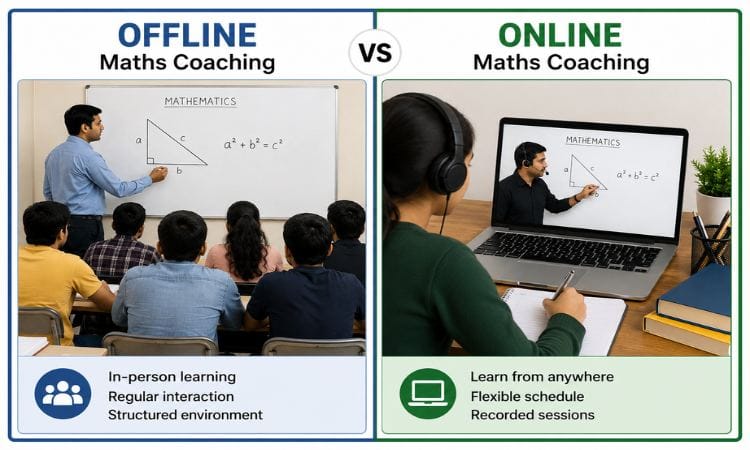
In a group class, some students hesitate to ask questions because they do not want to appear weak in front of others. As a result, their doubts remain unresolved.
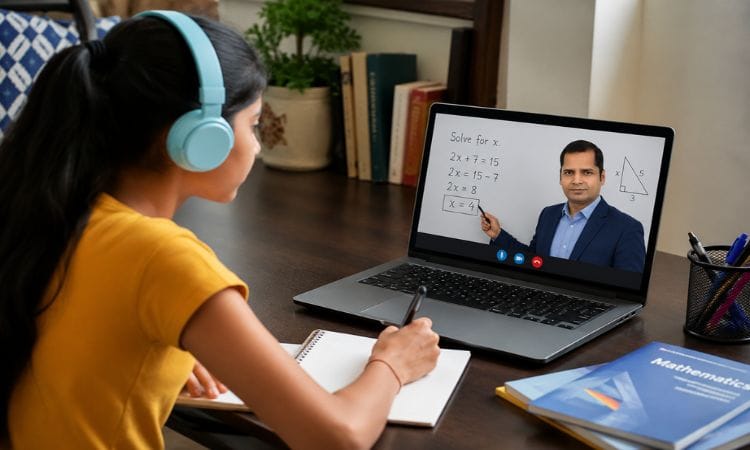
One-on-one online Maths classes can provide a more focused learning environment. Since the teacher works with one student at a time, the lesson can be adjusted according to the student’s understanding and learning speed.
Some important benefits include:
Individual attention: The tutor can focus on the student’s specific learning gaps.
Flexible teaching pace: Difficult topics can be explained again without holding back an entire batch.
Better doubt-solving: Students get more opportunities to ask questions freely.
Focused practice: The tutor can select questions according to the student’s current level.
Regular feedback: Parents can understand which areas are improving and where more work is needed.
One-on-one tuition is not a shortcut to better marks. Students still need consistent practice, but individual attention can make learning more focused and manageable.
Weak in Maths? Join Shamsher Sir Online Classes
If your child is struggling and losing confidence, there’s no need to wait for the next bad result.
At Shamsher Sir Online Classes, weak students can join one-on-one online maths classes for Classes 9-12. The focus is on:
- Finding the exact gaps in the basics
- Teaching concepts step by step, at your child’s pace
- Regular practice, doubt clearing, and test preparation
- Bringing back confidence along with marks
Book a demo class today and see the difference for yourself.
How You Can Support at Home
A tutor is only half the solution. A few small habits from your side help a lot:
- Fix a daily maths slot, even if it’s just 30 to 40 minutes.
- Don’t compare your child with a cousin or classmate.
- Celebrate small wins, like finishing a chapter or fixing a repeated mistake.
- Check in with the tutor every few weeks instead of waiting for exam results.
Progress in maths is rarely overnight. Often the first sign isn’t a higher score, it’s that your child stops avoiding the subject. That’s the real turning point.
Final Thoughts
The right maths tutor for a weak student is not necessarily the one with the biggest name or the most expensive classes. It is the teacher who understands the student’s difficulties, explains concepts patiently and provides the right support at every stage.
Before making a decision, attend a demo class, ask questions and observe how your child responds to the teaching approach.
With the right guidance, regular practice and patience, students can gradually overcome their fear of Maths and become more confident problem-solvers.