


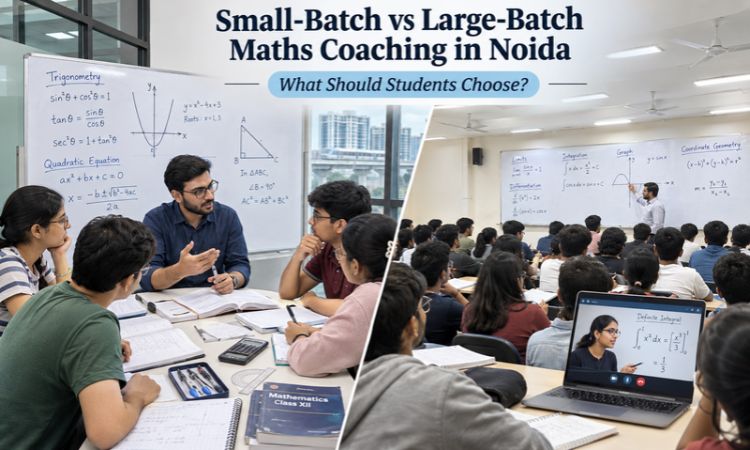
Picking a maths coaching class isn’t just about finding the closest institute or joining the batch everyone else is in. How a teacher explains ideas, handles questions and notices where a child is stuck can change how a student feels about maths altogether.
In Noida, families have plenty of choices: big classroom batches, smaller groups and personalised online classes. Each works well for some students and poorly for others. The right pick depends on where your child is right now, how quickly they learn and what they’re aiming for.
Some students do well learning alongside a large group. Others need more time, steady feedback and the freedom to ask “silly” questions without feeling embarrassed. So before you choose small-batch maths coaching in Noida or a big classroom, it helps to know how each one really works.
What Is Small-Batch Maths Coaching?
In a small batch, one teacher works with a limited number of students at a time. In a large classroom, attention gets divided among many learners. In a smaller group, it’s far easier for the teacher to spot who is struggling.
Say a student is stuck on algebra or can’t make sense of trigonometry. In a small batch, the teacher has a better chance of noticing it early and explaining the idea again in a different way.
Some common benefits:
- More chances to ask questions: Doubts can be cleared during the lesson, not saved up for later.
- A clearer picture of each student’s progress: The teacher can see which topics are solid and which need more practice.
- A comfortable atmosphere: Students who stay quiet in big groups often open up in smaller ones.
- More focused practice: Questions can be matched to the group’s level.
One caution, though. A small batch doesn’t automatically mean personal attention. The teacher’s quality, their teaching style and how they handle doubts still matter a great deal.
What Is Large-Batch Maths Coaching?
Large-batch coaching puts many students in one classroom. These classes usually run on a fixed timetable and a planned syllabus, with the teacher explaining each topic to the whole group.
This suits students who already have a fair grasp of maths and are comfortable learning in a group. A student preparing for board exams, for instance, can benefit from structured lessons, regular practice questions and discussions of common exam patterns.
The advantages:
- Structured learning: A set schedule and syllabus keep things organised.
- Peer learning: Watching classmates tackle a problem differently can open up new methods.
- Group discussion: You often learn from doubts someone else raises.
- A steady routine: Fixed timings help students stay consistent.
The main drawback is individual attention. With so many students in one room, it’s hard for a teacher to understand each child’s specific gaps.
Small-Batch vs Large-Batch Maths Coaching in Noida: Key Differences
Both formats can help a student improve, but neither suits everyone. Here’s a quick comparison:
Factor | Small-Batch Coaching | Large-Batch Coaching |
|---|---|---|
Class size | Limited number of students | More students in one class |
Individual attention | More opportunity for personal attention | Attention is shared across the group |
Doubt-solving | More time to clear doubts | Doubts may have to wait for a suitable moment |
Learning pace | Easier to adjust | Usually follows a common classroom pace |
Participation | More chances to interact | Depends on class size and teaching style |
Best suited for | Students who need closer guidance | Students comfortable with group learning |
The number of seats in the room isn’t the whole story. What matters more is whether the teacher checks each student’s understanding, reviews mistakes and gives children enough time to practise.
Which Type of Maths Coaching Is Better for Weak Students?
A child who finds maths hard usually needs more than the same formula explained one more time. There may be gaps in the basics, trouble understanding what a question is asking, or difficulty applying what they’ve learned.
A smaller batch can help here, because the teacher has more room to find the weak spots. Instead of rushing ahead, they can go back to earlier concepts and give extra practice.
Some students need even more support than that.
One-on-one online maths classes can be especially useful for students who are struggling. In a one-to-one class, the teacher’s full attention is on a single student’s doubts, pace and way of solving problems. A child who feels shy asking questions in a group often finds it much easier to speak up.
Take a Class 9 student who is struggling with algebra. The teacher can first work out whether the real problem is basic calculation, equations or simply understanding the question. The lessons can then target exactly those gaps.
This approach works well for students in Classes 9–12, particularly when the basics need attention before moving on to harder topics.
Is Small-Batch Coaching Better for Class 10 and 12 Board Exams?
Not necessarily. Both small and large batches can prepare students for the CBSE Class 10 and Class 12 Maths exams. What counts is whether the teaching matches the student’s level of preparation.
Students who understand the concepts but need regular practice often do fine in a well-run larger batch. They can follow the syllabus, solve important questions and learn from class discussions.
Students who keep repeating the same mistakes, or who struggle with particular chapters, usually do better in a smaller group.
For board exam preparation, look for coaching that offers:
- Clear explanations of NCERT concepts
- Regular practice with different types of questions
- Step-by-step solutions and proper presentation of answers
- Identification of weak chapters
- Revision and mock tests before the exams
Good maths teaching helps students understand why a method works, not just memorise how to apply it.
What About Online One-to-One Maths Coaching?
Classroom coaching isn’t the only route. Online maths tuition has become a practical option, especially for students who want focused learning without travelling to a coaching centre.
In a live one-to-one session, the student works directly with the teacher, who can explain questions, go through calculations and answer doubts based on what that student actually understands.
This format can be a good fit when:
- A student’s maths fundamentals are weak
- School lessons are moving faster than the student can follow
- Help is needed with only a few chapters
- Regular classroom coaching hasn’t cleared their doubts
- A personal study plan would suit them better than a common batch schedule
Online classes also let students learn from home. Just check that the sessions are truly interactive, that your child can ask questions freely and that their progress is reviewed regularly.
How Should Parents Choose the Right Maths Coaching in Noida?
Before enrolling your child, look past batch size, advertisements and fee comparisons. A few practical questions can guide you.
1. Does the teacher understand your child’s current level?
A student who struggles with basic equations needs a different approach from one preparing for JEE Mathematics. A good teacher figures this out before planning lessons.
2. Can your child ask doubts comfortably?
Many students hesitate to speak up in front of a big group. Find out whether the class makes real time and space for doubts.
3. Is the focus on understanding or just finishing the syllabus?
Completing chapters quickly isn’t the same as learning. Ask how the teacher checks that students can solve questions on their own.
4. Are mistakes and weak topics reviewed regularly?
Regular feedback shows a student where they’re going wrong. Look for a teaching style that includes practice and correction, not lectures alone.
5. Does the class format suit your child?
A confident student may enjoy group learning. A child with weak fundamentals may need a smaller batch or one-to-one guidance.
Final Verdict: Small Batch, Large Batch or One-to-One?
No single format works for every maths student.
Large batches suit students who are comfortable with a common pace and want structured classroom practice. Smaller batches help students who do better with closer guidance, more interaction and extra time for doubts. And for students who are well behind or have lost confidence in maths, personalised one-to-one learning is worth serious consideration.
When you compare small-batch maths coaching in Noida, focus on the quality of teaching, your child’s individual progress and the attention they actually receive. A smaller class only helps if it leads to better understanding.
In the end, the best maths coaching is the one that helps your child understand concepts, fix their mistakes and solve questions independently.