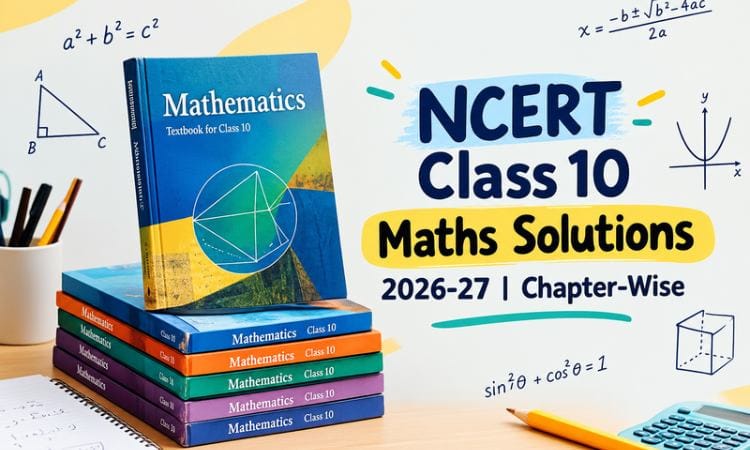
Finding the right solution to an NCERT Maths question is useful, but understanding why each step works is even more important. This page provides a chapter-wise guide to CBSE Class 10 Maths Solutions for the 2026–27 academic session, along with important concepts, formulas, question types and practical tips for solving NCERT exercises.
The current NCERT Class 10 Mathematics textbook contains 14 chapters covering Real Numbers, Algebra, Geometry, Trigonometry, Coordinate Geometry, Mensuration, Statistics and Probability. The 2026–27 NCERT reprint lists the same chapter sequence from Chapter 1, Real Numbers, to Chapter 14, Probability.
Use the chapter list below to find the topic you are studying, revise the relevant formulas, and then work through the exercise questions step by step.
Before You Start: What Is in Your 2026–27 Syllabus?
The NCERT textbook for Class 10 has 14 chapters, and the CBSE theory paper is 80 marks (plus 20 marks internal assessment). The 80 marks are split like this: Number Systems 6, Algebra 20, Coordinate Geometry 6, Geometry 15, Trigonometry 12, Mensuration 10, Statistics and Probability 11.
The 2026–27 CBSE curriculum document does not list the following topics, so do not spend your limited revision time on them for the board exam:
- The Constructions chapter
- Euclid’s division lemma and decimal expansions of rational numbers (Real Numbers now focuses on the Fundamental Theorem of Arithmetic and irrationality proofs)
- Division algorithm for polynomials
- Cross-multiplication method and equations reducible to linear form
- Completing the square as a method of solving (you only need factorisation and the quadratic formula)
- Theorem on areas of similar triangles, and the proof of the Pythagoras theorem
- Area of a triangle using coordinates
- Frustum of a cone and conversion of one solid into another
- Cumulative frequency graphs (ogives)
Syllabi can be updated, so always confirm with your school or on cbseacademic.nic.in before skipping anything.
CBSE Class 10 Maths: NCERT Chapter-Wise Solutions 2026-27
| Chapter | Chapter Name | Main Topics |
|---|---|---|
| 1 | Real Numbers | Fundamental Theorem of Arithmetic, irrational numbers |
| 2 | Polynomials | Zeroes and relationship between zeroes and coefficients |
| 3 | Pair of Linear Equations in Two Variables | Graphical, substitution and elimination methods |
| 4 | Quadratic Equations | Factorisation, roots and nature of roots |
| 5 | Arithmetic Progressions | nth term and sum of first n terms |
| 6 | Triangles | Similar figures and similarity of triangles |
| 7 | Coordinate Geometry | Distance formula and section formula |
| 8 | Introduction to Trigonometry | Ratios, standard angles and identities |
| 9 | Some Applications of Trigonometry | Heights and distances |
| 10 | Circles | Tangents and properties of tangents |
| 11 | Areas Related to Circles | Sector and segment of a circle |
| 12 | Surface Areas and Volumes | Surface area and volume of combinations of solids |
| 13 | Statistics | Mean, mode and median of grouped data |
| 14 | Probability | Theoretical probability |
The chapter sequence and the main sections above follow the current 2026–27 NCERT Class X Mathematics reprint.
Chapter 1 – Real Numbers
Key concepts covered
The chapter has two big ideas. First, the Fundamental Theorem of Arithmetic (FTA): every composite number can be written as a product of primes, and this factorisation is unique apart from the order of the primes. Second, irrational numbers: proving that numbers like √2, √3 and √5 cannot be written as p/q.
Exercise-wise solutions
- Exercise 1.1 – Prime factorisation, finding HCF and LCM, and reasoning questions such as “can 6ⁿ end with the digit 0?”
- Exercise 1.2 – Proofs of irrationality (√5, 3 + 2√5 and similar numbers)
Worked example. Find the HCF and LCM of 96 and 404.
96 = 2⁵ × 3 and 404 = 2² × 101.
HCF = product of the smallest power of each common prime = 2² = 4. LCM = product of the greatest power of every prime = 2⁵ × 3 × 101 = 9696.
Check: HCF × LCM = 4 × 9696 = 38784, and 96 × 404 = 38784. ✓
Important NCERT questions
- Prove that √2 (or √3, √5) is irrational. Assume √2 = p/q with p and q co-prime. Then p² = 2q², so p is even; write p = 2k, which gives q² = 2k², so q is even too. Both are even, which contradicts “co-prime”.
- Prove that 3 + 2√5 is irrational. If it were rational, then √5 = (r − 3)/2 would be rational, which is false.
- Show that 6ⁿ can never end in 0: 6ⁿ = 2ⁿ × 3ⁿ has no factor 5, but a number ending in 0 must be divisible by 5.
Quick recap
- HCF × LCM = product of the two numbers (true for two numbers only, not three).
- Always say “co-prime” when you start a proof by contradiction.
- 1 is neither prime nor composite.
Chapter 2 – Polynomials
Key concepts
A zero of a polynomial p(x) is a value k for which p(k) = 0. Graphically, the zeroes are the x-coordinates of the points where the graph meets the x-axis. A quadratic graph is a parabola (opening upward if a > 0, downward if a < 0) and can have 0, 1 or 2 zeroes. In general, a polynomial of degree n has at most n zeroes.
For a quadratic ax² + bx + c with zeroes α and β:
- Sum of zeroes: α + β = −b/a
- Product of zeroes: αβ = c/a
Exercise-wise solutions
- Exercise 2.1 – Reading the number of zeroes from a graph.
- Exercise 2.2 – Finding zeroes of quadratics, verifying the sum/product relationship, and forming a quadratic from a given sum and product.
Worked example. Find the zeroes of 6x² − 3 − 7x and verify the relationship.
Write it in standard form: 6x² − 7x − 3. Split the middle term: 6x² − 9x + 2x − 3 = 3x(2x − 3) + 1(2x − 3) = (2x − 3)(3x + 1).
Zeroes: x = 3/2 and x = −1/3.
Verify: sum = 3/2 − 1/3 = 7/6, and −b/a = 7/6. ✓ Product = (3/2)(−1/3) = −1/2, and c/a = −3/6 = −1/2. ✓
Important questions
- Form a quadratic polynomial when the sum and product of zeroes are given. The polynomial is k[x² − (sum)x + (product)]. For sum = √2 and product = 1/3, taking k = 3 gives 3x² − 3√2x + 1.
- Find the zeroes and verify the relationship with the coefficients.
- Read the number of zeroes from a given graph.
Quick recap
- Watch the sign: the sum is −b/a, not b/a.
- Always bring the polynomial to standard form before reading a, b and c.
- In this syllabus the relationship is for quadratics
Chapter 3 – Pair of Linear Equations in Two Variables
Key concepts
Two equations a₁x + b₁y + c₁ = 0 and a₂x + b₂y + c₂ = 0 can behave in three ways:
- a₁/a₂ ≠ b₁/b₂ – lines intersect, exactly one solution, consistent.
- a₁/a₂ = b₁/b₂ = c₁/c₂ – lines coincide, infinitely many solutions, consistent (dependent).
- a₁/a₂ = b₁/b₂ ≠ c₁/c₂ – lines are parallel, no solution, inconsistent.
You solve a pair by the graphical method, or algebraically by substitution or elimination.
Exercise-wise solutions
The exercises move from forming equations from a situation, to the graphical method and consistency conditions, to substitution and elimination, and finally to word problems (ages, fractions, speed and distance, boat-and-stream).
Worked example. Solve 2x + 3y = 11 and 2x − 4y = −24.
Subtract the second from the first: 7y = 35, so y = 5. Put y = 5 in the first: 2x + 15 = 11, so x = −2.
Check in the second equation: 2(−2) − 4(5) = −4 − 20 = −24. ✓
Important questions
- Find k so that 3x + y = 1 and (2k − 1)x + (k − 1)y = 2k + 1 have no solution. For no solution, 3/(2k − 1) = 1/(k − 1) ≠ 1/(2k + 1). The first equality gives 3k − 3 = 2k − 1, so k = 2. At k = 2, 1/(k − 1) = 1 while 1/(2k + 1) = 1/5, so the “≠” condition holds too. k = 2.
- Word problems that must be converted into two equations (always define your variables first).
- Check consistency from the ratios, and say what the lines look like.
Quick recap
- Always write the final answer as an ordered pair (x, y) and verify it in both
- For word problems, start with “Let the … be x and … be y”.
Chapter 4 – Quadratic Equations
Key concepts
A quadratic equation has the standard form ax² + bx + c = 0, a ≠ 0. You can solve it by factorisation or by the quadratic formula:
x = (−b ± √(b² − 4ac)) / 2a
The discriminant D = b² − 4ac tells you the nature of the roots:
- D > 0 – two distinct real roots
- D = 0 – two equal real roots (each equal to −b/2a)
- D < 0 – no real roots
(Completing the square is how the formula is derived, but you are not asked to use it as a solving method.)
Exercise-wise solutions
The exercises cover checking whether an equation is quadratic and forming one from a situation, solving by factorisation, and solving by the formula and finding the nature of roots, including real-life problems.
Worked example. Solve 2x² − 7x + 3 = 0.
a = 2, b = −7, c = 3. D = 49 − 24 = 25.
x = (7 ± 5)/4, so x = 3 or x = 1/2.
Important questions
- Find k for equal roots in kx(x − 2) + 6 = 0. Rewrite as kx² − 2kx + 6 = 0. D = 4k² − 24k = 4k(k − 6) = 0. Since k ≠ 0, k = 6.
- Two numbers add up to 27 and multiply to 182. Let one be x: x(27 − x) = 182, so x² − 27x + 182 = 0. D = 729 − 728 = 1, so x = (27 ± 1)/2 = 14 or 13. The numbers are 13 and 14.
- Speed, time and work problems that lead to a quadratic.
Quick recap
- Reject a root only when it makes no sense in the story (a negative length or age), not automatically.
- Be careful with signs while finding D, especially when b or c is negative.
Chapter 5 – Arithmetic Progressions
Key concepts
An AP is a list of numbers where the difference between consecutive terms is constant. That difference is the common difference d = aₙ₊₁ − aₙ.
- nth term: aₙ = a + (n − 1)d
- Sum of first n terms: Sₙ = (n/2)[2a + (n − 1)d], or Sₙ = (n/2)(a + l) where l is the last term
- A useful link: aₙ = Sₙ − Sₙ₋₁
- Sum of the first n natural numbers: n(n + 1)/2
Exercise-wise solutions
- Exercise 5.1 – Recognising an AP and finding a and d.
- Exercise 5.2 – Using aₙ = a + (n − 1)d.
- Exercise 5.3 – Using the sum formula.
- Exercise 5.4 – Higher-level and application problems (check with your teacher whether it is marked optional in your copy).
Worked example. Find the sum of the first 22 terms of 8, 3, −2, …
a = 8 and d = −5. S₂₂ = (22/2)[2(8) + 21(−5)] = 11[16 − 105] = 11 × (−89) = −979.
Important questions
- Which term of 3, 8, 13, … is 78? 3 + (n − 1)5 = 78, so n − 1 = 15 and n = 16.
- Find the 10th term of 2, 7, 12, …: a₁₀ = 2 + 9 × 5 = 47.
- Real-life problems (savings, seating in rows, prize amounts, stacking pipes).
Quick recap
- Choose between the two sum formulas: use (n/2)(a + l) when the last term is given.
- A negative d means the AP is decreasing. Do not drop the sign.
Chapter 6 – Triangles
Key concepts
Two triangles are similar when their corresponding angles are equal and their corresponding sides are in the same ratio. The key results are:
- Basic Proportionality Theorem (Thales): a line drawn parallel to one side of a triangle divides the other two sides in the same ratio. You need to be able to prove this one.
- Converse of BPT: if a line divides two sides in the same ratio, it is parallel to the third side.
- Similarity criteria: AA, SSS and SAS.
The Pythagoras theorem is no longer a proof you are asked to write in this chapter, but you will keep using it as a tool in other chapters.
Exercise-wise solutions
- Exercise 6.1 – Basics of similar figures and similar triangles.
- Exercise 6.2 – BPT and its converse in numerical and proof questions.
- Exercise 6.3 – Similarity criteria (AA, SSS, SAS) and proofs.
Worked example. In △ABC, DE ∥ BC with D on AB and E on AC. If AD = 1.5 cm, DB = 3 cm and AE = 1 cm, find EC.
By BPT, AD/DB = AE/EC. So 1.5/3 = 1/EC, which gives EC = 2 cm.
Important questions
- Prove the Basic Proportionality Theorem.
- Prove that two triangles are similar using AA, SAS or SSS, then use the result to find a missing side.
- Problems where parallel lines in a trapezium create similar triangles.
Quick recap
- Compare a part with a part (AD/DB) or a whole with a whole (AB/AC). Mixing them (AD/AB with AE/EC) is the most common error.
- Write the vertices in matching order when naming similar triangles (△ABC ~ △PQR means A↔P, B↔Q, C↔R).
- In every proof, write: Given, To prove, Construction (if any), Proof.
Chapter 7 – Coordinate Geometry
Key concepts
- Distance formula: d = √[(x₂ − x₁)² + (y₂ − y₁)²]. Distance from the origin is √(x² + y²).
- Section formula (internal division in the ratio m₁ : m₂): the point is ( (m₁x₂ + m₂x₁)/(m₁ + m₂), (m₁y₂ + m₂y₁)/(m₁ + m₂) ).
- Midpoint (the case m₁ = m₂): ( (x₁ + x₂)/2, (y₁ + y₂)/2 ).
Exercise-wise solutions
- Exercise 7.1 – Distance formula: distance between points, collinearity, identifying shapes such as isosceles triangles, squares and parallelograms, and finding unknown coordinates.
- Exercise 7.2 – Section formula and midpoint.
Worked example. Find the point on the x-axis equidistant from (2, −5) and (−2, 9).
Let the point be (x, 0). Then (x − 2)² + 25 = (x + 2)² + 81. So −4x + 29 = 4x + 85, which gives −8x = 56 and x = −7. The point is (−7, 0).
Another quick one. The point dividing (4, −3) and (8, 5) in the ratio 3 : 1 is ( (3 × 8 + 1 × 4)/4, (3 × 5 + 1 × (−3))/4 ) = (7, 3).
Important questions
- Show that given points are the vertices of a square (all four sides equal and both diagonals equal).
- Show three points are collinear using AB + BC = AC.
- Find the ratio in which a point divides a line segment, or find an unknown coordinate.
Quick recap
- In the section formula, m₁ multiplies the second point’s coordinates and m₂ the first point’s. Swapping them gives the wrong point.
- Square the differences before adding, and never forget the square root at the end.
Chapter 8 – Introduction to Trigonometry
Key concepts
For an acute angle A in a right-angled triangle:
- sin A = opposite / hypotenuse
- cos A = adjacent / hypotenuse
- tan A = opposite / adjacent = sin A / cos A
- cosec A = 1 / sin A, sec A = 1 / cos A, cot A = 1 / tan A
Standard values you must know cold:
Angle | 0° | 30° | 45° | 60° | 90° |
sin | 0 | 1/2 | 1/√2 | √3/2 | 1 |
cos | 1 | √3/2 | 1/√2 | 1/2 | 0 |
tan | 0 | 1/√3 | 1 | √3 | not defined |
Three identities hold for every angle for which the ratios are defined:
- sin²A + cos²A = 1
- 1 + tan²A = sec²A
- 1 + cot²A = cosec²A
(Ratios of complementary angles, like sin(90° − A) = cos A, are not listed as a separate topic in the current CBSE content, but they are true and often handy.)
Exercise-wise solutions
- Exercise 8.1 – Finding trigonometric ratios from the sides of a right triangle, or from one given ratio.
- Exercise 8.2 – Evaluating expressions using the values at 0°, 30°, 45°, 60° and 90°.
- Exercise 8.3 – Proving identities.
Worked example. If 3 tan A = 4, find sin A and cos A.
tan A = 4/3, so take the opposite side as 4 and the adjacent side as 3. The hypotenuse is √(16 + 9) = 5. Therefore sin A = 4/5 and cos A = 3/5.
Important questions
- Evaluate 2 tan²45° + cos²30° − sin²60° = 2(1) + 3/4 − 3/4 = 2.
- Prove sec A (1 − sin A)(sec A + tan A) = 1. LHS = (1/cos A)(1 − sin A)(1 + sin A)/cos A = (1 − sin²A)/cos²A = cos²A/cos²A = 1. ✓
- Express all other ratios in terms of one given ratio.
Quick recap
- When proving an identity, work on one side (usually the more complicated one) until it matches the other. Do not move terms across the equals sign.
- sin²A means (sin A)². And sin(A + B) is not sin A + sin B.
- Ratios depend only on the angle, not on how big the triangle is.
- tan 90°, sec 90°, cosec 0° and cot 0° are not defined.
Chapter 9 – Some Applications of Trigonometry
Key concepts
The angle of elevation is the angle between the horizontal line and your line of sight when you look up at an object. The angle of depression is the same angle when you look down. Because the horizontal lines are parallel, the angle of depression from the top of a tower equals the angle of elevation from the ground to the top (alternate angles).
In this syllabus, problems involve at most two right triangles, with angles of 30°, 45° and 60° only.
Exercise-wise solutions
- Exercise 9.1 – A single exercise of height-and-distance problems: towers, poles, buildings, kites, ladders and shadows.
Worked example. From a point on the ground 15 m from the foot of a tower, the angle of elevation of its top is 60°. Find the height.
tan 60° = height / 15, so height = 15√3 ≈ 15 × 1.732 = 25.98 m.
Important questions
- Two angles of elevation from two points on the same line (two right triangles sharing the same height).
- A tower on top of a building, or two poles of different heights.
- Angle of depression problems from a cliff, lighthouse or balcony.
Quick recap
- Draw a clean figure first and mark the right angle and the given angle. Half the marks are in the diagram.
- tan usually links height and ground distance, but choose sin or cos if the hypotenuse is involved.
- Add the observer’s eye height when the question gives it.
Chapter 10 – Circles
Key concepts
A tangent touches a circle at exactly one point (the point of contact); a secant cuts it at two points. From a point inside the circle there is no tangent, from a point on the circle there is exactly one, and from an outside point there are exactly two.
Two theorems you must be able to prove:
- The tangent at any point of a circle is perpendicular to the radius through the point of contact.
- The lengths of the two tangents drawn from an external point to a circle are equal.
A very useful consequence: if P is at distance d from the centre and the radius is r, the tangent length is √(d² − r²).
Exercise-wise solutions
- Exercise 10.1 – Concept-based and multiple-choice style questions on tangents.
- Exercise 10.2 – Numerical and proof questions using the two theorems.
Worked example. A tangent PQ at point Q of a circle with centre O meets OP = 13 cm. If OQ = 12 cm, find PQ.
OQ is a radius and is perpendicular to PQ, so △OQP is right-angled at Q. PQ = √(13² − 12²) = √(169 − 144) = √25 = 5 cm.
Important questions
- Prove that the tangent is perpendicular to the radius (proof by contradiction using the shortest-distance idea).
- Prove that the lengths of tangents from an external point are equal.
- A quadrilateral ABCD circumscribes a circle: prove AB + CD = AD + BC.
- Prove that the tangents at the ends of a diameter are parallel.
Quick recap
- The moment you see a tangent and a radius, mark a 90°
- The angle between two tangents and the angle between the two radii to the points of contact add up to 180°.
- Give a reason for every line in a proof (“tangent ⊥ radius”, “tangents from an external point are equal”).
Chapter 11 – Areas Related to Circles
Key concepts
Circumference = 2πr and area = πr². For a sector with central angle θ (in degrees):
- Length of arc = (θ/360) × 2πr
- Area of sector = (θ/360) × πr²
- Area of minor segment = area of sector − area of the triangle formed by the two radii and the chord
- Area of major segment = πr² − area of minor segment
- Perimeter of a sector = arc length + 2r
In this syllabus, segment problems use central angles of 60°, 90° and 120° only.
Exercise-wise solutions
- Exercise 11.1 – Circumference and area of circles, sectors and segments, and areas of combined figures (for example, the region swept by a minute hand, or a design made of arcs and squares).
Worked example. Find the area of the minor segment of a circle of radius 10 cm with central angle 90° (use π = 3.14).
Area of sector = (90/360) × 3.14 × 100 = 78.5 cm². Area of triangle = (1/2) × 10 × 10 = 50 cm². Segment = 78.5 − 50 = 28.5 cm².
Another quick one. A minute hand of length 14 cm moves for 5 minutes. It turns through 30°, so the area swept is (30/360) × (22/7) × 14 × 14 = ≈ 51.33 cm².
Important questions
- Area of a sector and the length of its arc from the same data.
- Area of a segment for 60°, 90° or 120°.
- Shaded-region problems: find the area of the bigger shape and subtract the area you do not want.
Quick recap
- Use the radius, not the diameter. Halve the diameter first.
- The perimeter of a sector includes the two straight radii, not just the curved arc.
- Use the value of π given in the question (22/7 or 3.14).
Chapter 12 – Surface Areas and Volumes
Key concepts
Solid | Curved / lateral surface area | Total surface area | Volume |
Cuboid (l, b, h) | 2h(l + b) | 2(lb + bh + hl) | lbh |
Cube (side a) | 4a² | 6a² | a³ |
Cylinder | 2πrh | 2πr(r + h) | πr²h |
Cone | πrl | πr(l + r) | (1/3)πr²h |
Sphere | 4πr² | 4πr² | (4/3)πr³ |
Hemisphere | 2πr² | 3πr² | (2/3)πr³ |
For a cone, the slant height is l = √(r² + h²). In this syllabus you work with combinations of any two of these solids.
Exercise-wise solutions
- Exercise 12.1 – Surface area of combined solids (toys, tents, capsules, containers).
- Exercise 12.2 – Volume of combined solids.
Worked example. A toy is a cone of radius 3.5 cm sitting on a hemisphere of the same radius. The total height of the toy is 15.5 cm. Find its total surface area.
Cone height = 15.5 − 3.5 = 12 cm. Slant height l = √(12² + 3.5²) = √156.25 = 12.5 cm.
Visible surface = curved surface of cone + curved surface of hemisphere = πrl + 2πr² = π(3.5)(12.5) + 2π(3.5)² = π(43.75 + 24.5) = π × 68.25.
With π = 22/7, the total surface area is 214.5 cm².
Important questions
- A cylinder with a hemisphere on each end (a capsule): find surface area and volume.
- A cone on a hemisphere, or a hemisphere scooped out of a cylinder.
- A tent made of a cylinder and a cone (find the canvas needed, remembering the cylinder has no top and the cone has no base).
Quick recap
- When two solids are joined, the joined faces are hidden. Add only the visible curved or flat surfaces. Do not add the two total surface areas.
- Volume of a combination = sum of the volumes (or a difference if one is hollowed out).
- Subtract the radius of the hemisphere from the total height to get the cone’s height.
Chapter 13 – Statistics
Key concepts
For grouped data with class marks xᵢ and frequencies fᵢ:
- Mean (direct method): x̄ = Σfᵢxᵢ / Σfᵢ
- Mean (assumed mean method): x̄ = a + Σfᵢdᵢ / Σfᵢ, where dᵢ = xᵢ − a
- Mean (step-deviation method): x̄ = a + h × Σfᵢuᵢ / Σfᵢ, where uᵢ = (xᵢ − a)/h
- Mode: l + [(f₁ − f₀) / (2f₁ − f₀ − f₂)] × h
- Median: l + [(n/2 − cf) / f] × h
Here, for mode, l is the lower limit of the modal class, f₁ its frequency, f₀ the frequency before it and f₂ the frequency after it. For median, l is the lower limit of the median class, cf is the cumulative frequency of the class just before it, f is its frequency and h is the class size.
Exercise-wise solutions
- Exercise 13.1 – Mean of grouped data (all three methods).
- Exercise 13.2 – Mode of grouped data.
- Exercise 13.3 – Median of grouped data.
Worked example (median). Classes 0–10, 10–20, 20–30, 30–40, 40–50 with frequencies 5, 8, 12, 15, 10.
n = 50, so n/2 = 25. Cumulative frequencies are 5, 13, 25, 40, 50, so the median class is 20–30. Here l = 20, cf = 13, f = 12, h = 10.
Median = 20 + [(25 − 13)/12] × 10 = 20 + 10 = 30.
Worked example (mode). Modal class 40–50 with f₁ = 20, f₀ = 12, f₂ = 10, h = 10.
Mode = 40 + [(20 − 12)/(40 − 12 − 10)] × 10 = 40 + (8/18) × 10 ≈ 44.44.
Important questions
- Find the mean by the step-deviation method when the numbers are large.
- Find the mode when the modal class is not the first or last class.
- Find the median using a cumulative frequency column.
- A frequently asked pattern: some frequencies are missing, but the mean or median is given. Form an equation and solve.
Quick recap
- For inclusive classes like 10–19, 20–29, first convert them to continuous classes (9.5–19.5, 19.5–29.5) before finding the median or mode.
- Use the cumulative frequency of the class before the median class, not of the median class itself.
- As a rough cross-check, for moderately skewed data, 3 × median ≈ mode + 2 × mean.
Chapter 14 – Probability
Key concepts
The classical definition: P(E) = number of outcomes favourable to E / total number of equally likely outcomes.
- 0 ≤ P(E) ≤ 1
- P(E) + P(not E) = 1
- A sure event has probability 1, an impossible event has probability 0
Facts you are expected to know: a die has 6 outcomes; two coins have 4 outcomes (HH, HT, TH, TT); two dice have 36 outcomes; a deck has 52 cards in 4 suits of 13, with 26 red, 26 black, 4 aces and 12 face cards (J, Q, K).
Exercise-wise solutions
- Exercise 14.1 – Probability of events involving coins, dice, cards, bags of coloured balls and real-life situations.
Worked example. Two dice are thrown together. Find the probability that the sum is 8.
Favourable outcomes: (2,6), (3,5), (4,4), (5,3), (6,2), which is 5 outcomes. Total = 36. So P = 5/36.
Important questions
- A bag has 3 red and 5 black balls. P(red) = 3/8 and P(not red) = 5/8.
- One card is drawn from a well-shuffled deck. P(king of red colour) = 2/52 = 1/26.
- A die is thrown once. P(a prime number) = 3/6 = 1/2, because the primes are 2, 3 and 5.
Quick recap
- 1 is not a prime number.
- On two dice, (2, 3) and (3, 2) are different outcomes.
- The outcomes must be equally likely for the classical formula to apply.
Please note: Chapter list and syllabus checked against the 2026–27 CBSE curriculum. Exercise numbering can differ slightly between reprints, so match topics, not just numbers.
How to Use NCERT Class 10 Maths Solutions Effectively
Solutions are a tool, not a shortcut. Used well, they are like a patient teacher sitting next to you. Used badly, they only create the illusion that you understand. Here is a simple routine that works.
Try the Question Before Checking the Solution
Give every question a genuine attempt, even if it is only five or ten minutes. Write down what is given, what you need to find and which formula or theorem might connect them. Even a failed attempt trains your brain to look for the right idea.
Understand the Steps, Not Just the Final Answer
When you open a solution, ask “why did this step come next?” at every line. Why was the middle term split that way? Why did the solution take tan and not sin? If you cannot explain a step in your own words, you have not learnt it yet.
Use Solutions to Identify Your Mistakes
Compare your working with the solution and mark where you went wrong. Was it a concept error (wrong formula), a calculation error (sign or arithmetic) or a presentation error (missing steps)? Keep a small “mistake notebook”. You will find that the same two or three errors repeat, and fixing those is the fastest way to gain marks.
Practise the Same Question Again Without Looking
A day or two later, close the book and solve the same question from scratch. If you can do it cleanly, you own the method. If not, repeat the cycle. This is far more powerful than solving fifty new questions once.
Important Questions to Practise from NCERT Class 10 Maths
This is a focused NCERT-based list of questions that covers the concepts students should practise carefully before their exams. Practising these Class 10 Maths Important Questions, can help students identify weak areas and become more confident with different question patterns.
Questions Based on Important Concepts
- Irrationality proofs and HCF/LCM using prime factorisation (Real Numbers)
- Sum and product of zeroes, and forming a quadratic (Polynomials)
- Conditions for consistent, inconsistent and dependent pairs (Linear Equations)
- Nature of roots using the discriminant (Quadratic Equations)
- Proving the Basic Proportionality Theorem and the two tangent theorems
- Proving identities using sin²A + cos²A = 1
Questions Requiring Multiple Steps
- Word problems in Linear Equations and Quadratic Equations (form the equation, solve, then interpret)
- Combined-solid problems in Surface Areas and Volumes
- Height-and-distance problems with two triangles
- Median and mode of grouped data, and finding a missing frequency
- Shaded-region problems in Areas Related to Circles
Questions Students Commonly Get Wrong
- Writing the sum of zeroes as b/a instead of −b/a
- Mixing parts and wholes in BPT (AD/AB with AE/EC)
- Swapping m₁ and m₂ in the section formula
- Adding total surface areas of two joined solids instead of only the visible surfaces
- Using the diameter instead of the radius in circle questions
- Treating 1 as a prime number in Probability and Real Numbers
NCERT Class 10 Maths Solutions for Board Exam Preparation
How NCERT helps build board-exam fundamentals. CBSE sets the paper around the NCERT syllabus. In the 2026–27 curriculum, about 54% of the 80 marks (Standard Maths) test recall and understanding, about 24% test application, and about 22% test analysis and higher-order thinking. A student who understands the NCERT methods can handle all three. The paper also includes case-based questions, which are real-life situations built on the same chapters.
How to practise solved and unsolved questions. First read and understand the solved examples in each chapter, because they show the exact style of reasoning expected. Then attempt the exercise questions yourself. Finally, practise a few extra questions from your teacher or a question bank to stretch your thinking.
How to use NCERT solutions during revision. In the last weeks, do not re-read everything. Revisit your mistake notebook, re-solve the questions you got wrong earlier, and revise the formula recap of each chapter. Since algebra carries 20 marks, give Chapters 2 to 5 the most repeat practice, then Geometry (15) and Trigonometry (12).
Importance of showing proper steps in Maths answers. CBSE awards marks step by step: the formula, the substitution, the calculation and the final statement. A student who writes the right method but slips in the last line can still earn most of the marks, while a bare answer with no working may earn little. Always draw neat figures, write units, and finish with a clear conclusion.
Good to know:
- CBSE conducts Class 10 board exams in two phases, a main exam in February–March and an optional second exam in May to improve scores. Check cbse.gov.in for the latest date sheet and rules.
- Calculators are not allowed in the exam hall, so practise your calculations by hand.
- The 20 internal-assessment marks come from a pen-and-paper test and multiple assessments (10), a portfolio (5) and a lab practical (5).
Final Takeaway
Good Maths preparation is not about memorising hundreds of answers. It is about understanding a concept, selecting the right method and applying it accurately.
Use CBSE Class 10 Maths Solutions as a guide when you are stuck, to check your working, and to learn a better method. Then close the solution and solve the question yourself.
With regular practice across all 14 chapters, careful revision of formulas, and attention to mistakes, students can build the confidence needed to solve Class 10 Maths questions independently.
If you are struggling with concepts even after practising NCERT questions, getting structured guidance from an experienced Maths teacher can help you identify your weak areas and improve them systematically.