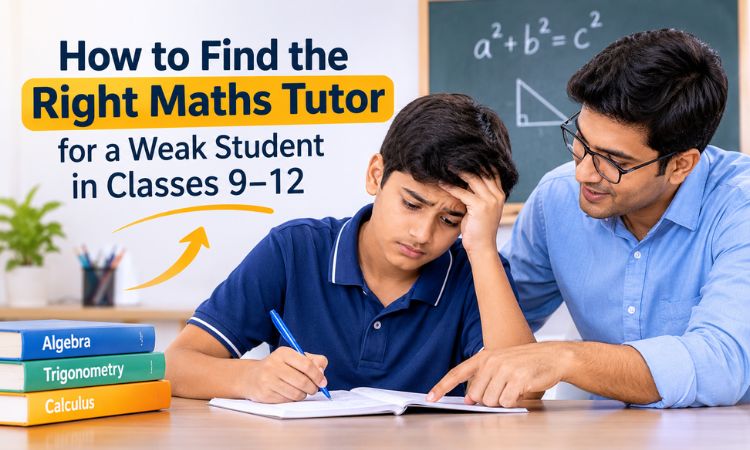



You understand the solution in class. However, at home, you get stuck on a similar question. You remember the formula, yet you cannot decide how to use it.
This gap often comes from limited practice with independent problem-solving. It’s easier to follow a teacher’s steps than to choose the right method yourself.
In order to improve, you just need to learn how to identify the given information, connect it to the right concept, and work through each step. So, let’s explore why students struggle with Maths questions and how to solve them independently.
5 Reasons Students Struggle to Solve Maths Questions
Understanding a concept is important, but it is only one part of solving a Maths problem. You also need to recognise which concept applies, choose the right method, and check whether your answer makes sense.
Here are five common reasons students struggle to do this independently.
1. Passive Learning
When a teacher solves a question on the board, it’s easy to follow along. You can understand every step without having to decide what comes next.
The problem appears when you try a question alone. You now have to make those decisions yourself.
For example, you may understand a quadratic equation when your teacher solves it, but struggle to decide whether to factorise it or use the quadratic formula when the question changes.
What helps: After watching an example, close your notes and solve a similar question from the beginning. Even if you get stuck, try to work out the next step before looking at the solution.
2. Weak Basics
Sometimes, the difficulty isn’t with the current chapter. It comes from an earlier concept that you haven’t fully understood.
You might understand a new algebra topic but make mistakes with negative numbers, fractions, or basic calculations. These small gaps can make more advanced questions difficult.
This is especially common when students move to higher classes and find that Maths requires them to use several concepts in the same question.
What helps: Identify the exact step where you get confused. If the problem comes from fractions, signs, or algebraic operations, revise that concept before attempting more difficult questions. Strengthening your Maths foundation can make later topics easier to handle.
3. Formula Memorisation
Remembering formulas is useful, but knowing a formula by heart doesn’t automatically tell you when to use it.
A student might remember the formula for the area of a circle but struggle when the question gives the diameter instead of the radius. The formula hasn’t changed; the student needs to recognise what the question is asking and identify the information provided.
The same issue appears in algebra, trigonometry, coordinate geometry, and other topics.
What helps: Whenever you learn a formula, understand what each term means, when the formula applies, and what information you need before using it. Then practise questions that present the same concept in different ways.
4. Limited Practice
Solving the same type of question repeatedly can make you comfortable with a particular method. However, it may not prepare you for questions that use different values, wording, or steps.
For example, you might solve five questions using the same method successfully but struggle when an exam combines two concepts in one problem.
This doesn’t mean your practice was useless. It means you need to move beyond familiar examples.
What helps: Start with a basic question, solve a few variations, and then attempt an unfamiliar one. Give yourself time to think instead of immediately checking a worked solution. You can also use these ways to improve your marks in Maths to make your practice more effective.
5. Fear of Mistakes
Some students hesitate to attempt a question because they don’t want to get the answer wrong. They keep checking formulas, looking at examples, or waiting for someone to confirm the first step.
Over time, this habit can make independent practice more difficult. You become more concerned about making mistakes than about understanding the question.
Mistakes are a normal part of learning Maths. What matters is finding out why an answer is wrong and avoiding the same mistake next time.
What helps: Try the question before checking the answer. If you make a mistake, find the step where your reasoning went wrong and attempt the question again. If the fear of getting questions wrong regularly stops you from practising, understanding mathematics anxiety may also help you identify what’s holding you back.
How to Identify What Is Stopping You from Solving Maths Questions?
Follow these four steps to determine what you’re stuck on and what you need to work on:
Step 1: Check Where You Get Stuck
If you cannot start a question, identify the given values, what you need to find, and which concept might apply.
Step 2: Find Your Errors
If your method seems correct but the answer is wrong, recheck calculations, signs, and intermediate steps to locate the mistake.
Step 3: Test Yourself with New Questions
You can work through examples, but if you are finding you are having difficulty with unfamiliar questions, practice other versions, but don’t refer to worked solutions.
Step 4: Test Your Recall
If you don’t remember the method, return to the question in a few days and attempt to solve it without referring to your notes.
Your difficulty determines your next step. Focus on the specific gap rather than repeating questions you can already solve.
6 Practical Ways to Solve Maths Questions on Your Own
There is much more to improving at Maths than solving multiple questions. Decisions must be made, mistakes must be identified and concepts must be used without relying on worked solutions. Here are 6 strategies you can use to develop independent maths problem solving.
1. Attempt Before Checking the Solution
Try to answer each question without cheating before checking the answer. Take a few minutes to think about the concept and go through the first step. When stuck, identify the exact point in which the logic fails. This helps you identify the skill you need to improve.
2. Identify What Is Given and What You Need to Find
In word problems, identify the known information from the unknown information. For instance, when a question provides a rectangle with length and width, be sure to determine both length and width and know what you need (area or perimeter). This will help you avoid selecting the incorrect formula.
3. Understand Why Each Step Works
Never copy formulas or operations without knowing what they do. At the end of each step, ask yourself why it is necessary and how it will help you get the answer.
If you are not able to communicate why, go back to the concept and discuss it again.
4. Progress from Easy to Unfamiliar Questions
Work one example to see how it works. Next, solve another similar problem on your own. Lastly, try a question using other values or a different approach.
This step-by-step approach helps you to solve maths problems independently, as opposed to memorising a sequence of steps.
5. Maintain a Maths Mistake Notebook
Write down the question, your wrong step, why it is wrong, and the correct step.
For instance, indicate if you confused the formula, omitted the negative sign or computed the error. Look through common errors before tests and work through similar questions to see if you have improved.
6. Reattempt Difficult Questions After a Gap
Review challenging questions the following day, or later in the week. Solve them without first reading your previous solution.
Explaining the process and arriving at the right answer on your own means you most likely understand the process, not just remember it.
What Should You Do When You Get Stuck on a Maths Question?
Getting stuck does not mean you cannot understand Maths. It means you need a better way to approach the problem.
- Reread the Question: Identify exactly what you need to calculate.
- List Known Values: Separate the given information from the unknown quantity.
- Recall the Concept: Think about the relevant formula, rule, or method.
- Try one Small Step: Break the problem into smaller parts or attempt a simpler version.
- Use a Hint if Needed: Ask your teacher or check a partial solution for guidance.
- Solve it Again: Close the solution and work through the entire question independently.
When learning how to solve maths questions on your own, asking for help is perfectly fine. The goal is to understand why each step works, not simply memorise the answer.
When Should You Ask a Maths Teacher for Help?
Consider asking a Maths teacher for help if you repeatedly make the same mistakes, struggle with basic concepts, or cannot decide which formula to use. When you have explored various strategies and approaches but continue to be stuck, you may find extra guidance useful.
It is these challenges that can account for students’ lack of self-assurance in maths, particularly when it comes to answering questions.
A good teacher should determine the holes in your logic, tell you why it works, and show you how to work through related problems. The idea is not to learn a solution by heart, but to build the confidence and ability to independently solve an unfamiliar question.
Conclusion
Understanding Maths is only the beginning. The key to real progress is being able to recognize the correct concept, select an appropriate method, and solve problems that are different from the ones you have seen before without using examples.
First, determine what your weak area is, then work that skill regularly. It is important to remember that errors play an integral part in learning and are not a sign of failure.
Looking for customised support to develop problem-solving skills? Forget about relying on a single tutor and move towards learning on your own with the help of Mathematics Home Tutor.