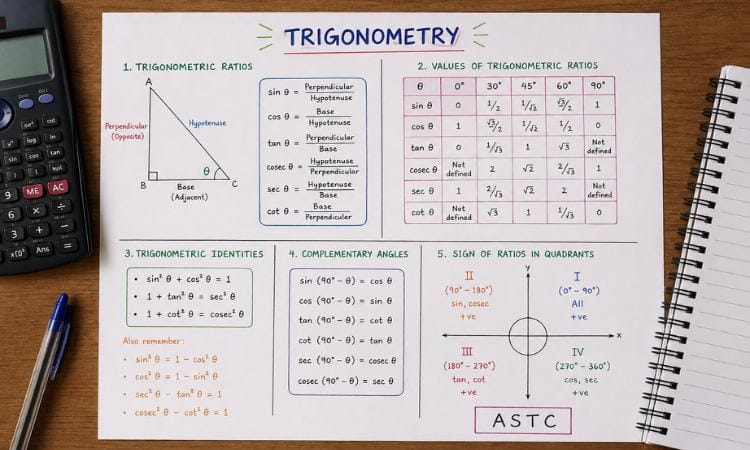



Many Class 12 students lose marks not because they cannot solve a question, but because the right formula does not come to mind at the right moment. This article puts all the important Class 12 Maths Formulas in one place, chapter by chapter, along with the conditions that go with them. Use it for quick revision, or keep it open while solving NCERT exercises. I have left out long derivations and added a short note only where students commonly go wrong.
Chapter-Wise Class 12 Maths Formulas
Formulas are grouped as they appear in the CBSE Class 12 Mathematics textbook. Check your current CBSE syllabus for your session, as the scope of some topics changes from year to year.
1. Relations and Functions
Counting
- Number of relations from set A (m elements) to set B (n elements): 2^(mn)
- Number of relations on a set with n elements: 2^(n²)
- Number of functions from A to B: nᵐ
- Number of one-one functions from A to B: n!/(n − m)! when n ≥ m, and 0 when n < m
- If both sets have n elements, number of bijections: n!
Types
- Equivalence relation: reflexive, symmetric and transitive
- One-one: f(x₁) = f(x₂) ⇒ x₁ = x₂
- Onto: range of f = codomain
- Bijective: one-one and onto
Composition and inverse
- (g∘f)(x) = g(f(x)), defined when the range of f lies within the domain of g
- In general, g∘f ≠ f∘g
- f is invertible if and only if f is bijective
- (g∘f)⁻¹ = f⁻¹∘g⁻¹
2. Inverse Trigonometric Functions
Note: sin⁻¹x means “the angle whose sine is x”. It is not 1/sin x, which is cosec x.
Principal value branches
| Function | Domain | Principal value range |
|---|---|---|
| sin⁻¹x | [−1, 1] | [−π/2, π/2] |
| cos⁻¹x | [−1, 1] | [0, π] |
| tan⁻¹x | R | (−π/2, π/2) |
| cot⁻¹x | R | (0, π) |
| sec⁻¹x | R − (−1, 1) | [0, π] − {π/2} |
| cosec⁻¹x | R − (−1, 1) | [−π/2, π/2] − {0} |
Identities
- sin⁻¹(−x) = −sin⁻¹x and tan⁻¹(−x) = −tan⁻¹x
- cos⁻¹(−x) = π − cos⁻¹x and cot⁻¹(−x) = π − cot⁻¹x
- sin⁻¹x + cos⁻¹x = π/2, for x ∈ [−1, 1]
- tan⁻¹x + cot⁻¹x = π/2, for x ∈ R
- sec⁻¹x + cosec⁻¹x = π/2, for |x| ≥ 1
- sin⁻¹(1/x) = cosec⁻¹x and cos⁻¹(1/x) = sec⁻¹x, for |x| ≥ 1
Sum and double-angle forms
- tan⁻¹x + tan⁻¹y = tan⁻¹[(x + y)/(1 − xy)], when xy < 1
- tan⁻¹x − tan⁻¹y = tan⁻¹[(x − y)/(1 + xy)], when xy > −1
- 2tan⁻¹x = sin⁻¹[2x/(1 + x²)], for |x| ≤ 1
- 2tan⁻¹x = cos⁻¹[(1 − x²)/(1 + x²)], for x ≥ 0
- 2tan⁻¹x = tan⁻¹[2x/(1 − x²)], for −1 < x < 1
Caution: sin⁻¹(sin x) = x only when x ∈ [−π/2, π/2]. For other values of x, first bring the angle into the principal range.
3. Matrices
- Matrix product AB exists only when the number of columns of A equals the number of rows of B.
- (AB)ᵢⱼ = Σₖ aᵢₖ bₖⱼ
- In general, AB ≠ BA
- (AB)C = A(BC) and A(B + C) = AB + AC
- AB = O does not imply A = O or B = O
- AI = IA = A
Transpose
- (Aᵀ)ᵀ = A
- (A + B)ᵀ = Aᵀ + Bᵀ
- (kA)ᵀ = kAᵀ
- (AB)ᵀ = BᵀAᵀ
Symmetric and skew-symmetric
- Symmetric: Aᵀ = A
- Skew-symmetric: Aᵀ = −A (all diagonal elements are zero)
- Every square matrix: A = ½(A + Aᵀ) + ½(A − Aᵀ), a symmetric part plus a skew-symmetric part
4. Determinants
A matrix is an arrangement of numbers, while its determinant is a single number. Only square matrices have determinants.
- 2 × 2: |a b; c d| = ad − bc
- 3 × 3, expanding along the first row: a₁₁(a₂₂a₃₃ − a₂₃a₃₂) − a₁₂(a₂₁a₃₃ − a₂₃a₃₁) + a₁₃(a₂₁a₃₂ − a₂₂a₃₁)
Properties
- |Aᵀ| = |A|
- Interchanging two rows (or columns) changes the sign of the determinant.
- If two rows (or columns) are identical or proportional, the determinant is 0.
- Multiplying one row by k multiplies the determinant by k.
- For a matrix of order n: |kA| = kⁿ|A|
- |AB| = |A||B|
- Adding a multiple of one row to another row does not change the determinant.
Minors, cofactors and inverse
- Cofactor: Aᵢⱼ = (−1)^(i + j) Mᵢⱼ, where Mᵢⱼ is the minor
- |A| = Σ aᵢⱼAᵢⱼ, along any one row or column
- Elements of one row multiplied by the cofactors of another row add up to 0
- adj A = transpose of the cofactor matrix
- A(adj A) = (adj A)A = |A| I
- |adj A| = |A|ⁿ⁻¹ for order n
- A⁻¹ = adj A / |A|
- Condition: A⁻¹ exists if and only if |A| ≠ 0 (A is non-singular)
- (AB)⁻¹ = B⁻¹A⁻¹ and (Aᵀ)⁻¹ = (A⁻¹)ᵀ
- Area of a triangle with vertices (x₁, y₁), (x₂, y₂), (x₃, y₃): ½ × |value of the 3 × 3 determinant with rows (x₁ y₁ 1), (x₂ y₂ 1), (x₃ y₃ 1)|
System AX = B
- If |A| ≠ 0: unique solution X = A⁻¹B
- If |A| = 0 and (adj A)B ≠ O: no solution (inconsistent)
- If |A| = 0 and (adj A)B = O: the system is either consistent with infinitely many solutions, or inconsistent
5. Continuity and Differentiability
- f is continuous at x = c if lim(x→c⁻) f(x) = lim(x→c⁺) f(x) = f(c)
- f is differentiable at c if the left-hand and right-hand derivatives exist and are equal
- Every differentiable function is continuous, but a continuous function need not be differentiable (for example, |x| at 0).
Standard derivatives
- d/dx (xⁿ) = nxⁿ⁻¹
- d/dx (eˣ) = eˣ
- d/dx (aˣ) = aˣ ln a, for a > 0
- d/dx (ln x) = 1/x, for x > 0
- d/dx (sin x) = cos x
- d/dx (cos x) = −sin x
- d/dx (tan x) = sec²x
- d/dx (cot x) = −cosec²x
- d/dx (sec x) = sec x tan x
- d/dx (cosec x) = −cosec x cot x
Inverse trigonometric derivatives
- d/dx (sin⁻¹x) = 1/√(1 − x²), for −1 < x < 1
- d/dx (cos⁻¹x) = −1/√(1 − x²), for −1 < x < 1
- d/dx (tan⁻¹x) = 1/(1 + x²)
- d/dx (cot⁻¹x) = −1/(1 + x²)
- d/dx (sec⁻¹x) = 1/(|x|√(x² − 1)), for |x| > 1
- d/dx (cosec⁻¹x) = −1/(|x|√(x² − 1)), for |x| > 1
Rules
- Product rule: (uv)′ = u′v + uv′
- Quotient rule: (u/v)′ = (u′v − uv′)/v², for v ≠ 0
- Chain rule: dy/dx = (dy/du)(du/dx)
- Logarithmic differentiation: for y = uᵛ with u > 0, take ln on both sides, which gives dy/dx = uᵛ[(v/u)u′ + v′ ln u]
- Implicit differentiation: differentiate both sides with respect to x, treating y as a function of x
- Parametric form: dy/dx = (dy/dt)/(dx/dt), for dx/dt ≠ 0
- Second derivative in parametric form: d²y/dx² = [d/dt(dy/dx)]/(dx/dt)
6. Applications of Derivatives
- Rate of change of y with respect to x: dy/dx
- Related rates: dy/dt = (dy/dx)(dx/dt)
- If f′(x) > 0 on an interval, f is strictly increasing there. If f′(x) < 0, it is strictly decreasing.
- Tangent at (x₀, y₀): y − y₀ = f′(x₀)(x − x₀)
- Normal at (x₀, y₀): y − y₀ = −[1/f′(x₀)](x − x₀), for f′(x₀) ≠ 0. If f′(x₀) = 0, the normal is the line x = x₀.
- Approximation: f(x + Δx) ≈ f(x) + f′(x)Δx
Maxima and minima
- Critical points: points where f′(x) = 0 or f′(x) does not exist.
- Necessary condition: if a differentiable function has a local maximum or minimum at an interior point c, then f′(c) = 0. The converse is false, so f′(c) = 0 alone does not guarantee a maximum or minimum.
- First derivative test: if f′ changes sign from + to − at c, it is a local maximum. If it changes from − to +, it is a local minimum. If there is no sign change, c is a point of inflexion.
- Second derivative test: if f′(c) = 0 and f″(c) < 0, it is a local maximum. If f″(c) > 0, it is a local minimum. If f″(c) = 0, the test fails, so use the first derivative test.
- Absolute maximum or minimum on [a, b]: compare the values of f at the critical points inside the interval and at the endpoints a and b.
7. Integrals
Add the constant of integration C to every indefinite integral below.
Basic integration formulas
- ∫xⁿ dx = xⁿ⁺¹/(n + 1) + C, for n ≠ −1
- ∫(1/x) dx = ln|x| + C
- ∫eˣ dx = eˣ + C
- ∫aˣ dx = aˣ/ln a + C
- ∫sin x dx = −cos x + C
- ∫cos x dx = sin x + C
- ∫sec²x dx = tan x + C
- ∫cosec²x dx = −cot x + C
- ∫sec x tan x dx = sec x + C
- ∫cosec x cot x dx = −cosec x + C
- ∫tan x dx = ln|sec x| + C
- ∫cot x dx = ln|sin x| + C
- ∫sec x dx = ln|sec x + tan x| + C
- ∫cosec x dx = ln|cosec x − cot x| + C
Standard forms
- ∫dx/√(a² − x²) = sin⁻¹(x/a) + C
- ∫dx/(a² + x²) = (1/a) tan⁻¹(x/a) + C
- ∫dx/(x² − a²) = (1/2a) ln|(x − a)/(x + a)| + C
- ∫dx/(a² − x²) = (1/2a) ln|(a + x)/(a − x)| + C
- ∫dx/√(x² − a²) = ln|x + √(x² − a²)| + C
- ∫dx/√(x² + a²) = ln|x + √(x² + a²)| + C
- ∫√(a² − x²) dx = (x/2)√(a² − x²) + (a²/2) sin⁻¹(x/a) + C
- ∫√(x² + a²) dx = (x/2)√(x² + a²) + (a²/2) ln|x + √(x² + a²)| + C
- ∫√(x² − a²) dx = (x/2)√(x² − a²) − (a²/2) ln|x + √(x² − a²)| + C
Methods
- Substitution: put t = g(x), so that ∫f(g(x))g′(x) dx = ∫f(t) dt
- ∫[f′(x)/f(x)] dx = ln|f(x)| + C
- Integration by parts: ∫u·v dx = u∫v dx − ∫[u′ ∫v dx] dx. Choose u in the order Inverse trigonometric, Logarithmic, Algebraic, Trigonometric, Exponential (ILATE).
- ∫eˣ[f(x) + f′(x)] dx = eˣ f(x) + C
- Partial fractions: (px + q)/[(x − a)(x − b)] = A/(x − a) + B/(x − b). For a repeated factor, 1/(x − a)² gives A/(x − a) + B/(x − a)². For an irreducible quadratic, use (Bx + D)/(x² + bx + c).
Definite integrals
- ∫ₐᵇ f(x) dx = F(b) − F(a), where F′(x) = f(x)
- ∫ₐᵇ f(x) dx = −∫ᵇₐ f(x) dx
- ∫ₐᵇ f(x) dx = (integral from a to c) + (integral from c to b), where a < c < b
- ∫ₐᵇ f(x) dx = ∫ₐᵇ f(a + b − x) dx
- ∫₀ᵃ f(x) dx = ∫₀ᵃ f(a − x) dx
- ∫₋ₐᵃ f(x) dx = 2∫₀ᵃ f(x) dx if f is even, and 0 if f is odd
- ∫₀²ᵃ f(x) dx = 2∫₀ᵃ f(x) dx if f(2a − x) = f(x), and 0 if f(2a − x) = −f(x)
8. Applications of Integrals
- Area under y = f(x), between x = a and x = b, above the x-axis: A = ∫ₐᵇ y dx
- Area bounded by x = g(y), the y-axis and the lines y = c, y = d: A = ∫ᵈ꜀ x dy, taking the modulus
- Area between two curves, where f(x) ≥ g(x) on [a, b]: A = ∫ₐᵇ [f(x) − g(x)] dx
- If the curves cross inside the interval, split the integral at the point of intersection and take each part as a positive area.
- Find the limits by solving f(x) = g(x). Always sketch the region first.
- If part of the curve lies below the x-axis, take the area of that part as positive. Do not let it cancel the part above the axis.
9. Differential Equations
- Order: the order of the highest-order derivative in the equation
- Degree: the power of the highest-order derivative, defined only when the equation is a polynomial in its derivatives
- The general solution has as many arbitrary constants as the order of the equation.
Variable separable
- dy/dx = f(x)g(y) ⇒ ∫dy/g(y) = ∫f(x) dx + C, for g(y) ≠ 0
Homogeneous
- dy/dx = F(x, y), where F(λx, λy) = λ⁰F(x, y)
- Put y = vx, so dy/dx = v + x(dv/dx), then separate variables. If the equation is in the form dx/dy, put x = vy.
Linear first order
- dy/dx + Py = Q, where P and Q are functions of x (or constants)
- Integrating factor: I.F. = e^(∫P dx)
- Solution: y · I.F. = ∫Q · I.F. dx + C
- For dx/dy + P₁x = Q₁, I.F. = e^(∫P₁ dy) and x · I.F. = ∫Q₁ · I.F. dy + C
10. Vector Algebra
- Position vector of P(x, y, z): r = xî + yĵ + zk̂, and |r| = √(x² + y² + z²)
- Vector AB = (position vector of B) − (position vector of A)
- Unit vector along a: â = a/|a|
- Direction cosines of a = a₁î + a₂ĵ + a₃k̂: l = a₁/|a|, m = a₂/|a|, n = a₃/|a|, with l² + m² + n² = 1
- Section formula (internal, ratio m : n): (mb + na)/(m + n)
- Section formula (external, ratio m : n): (mb − na)/(m − n)
- Midpoint of A and B: (a + b)/2
Dot product
- a · b = |a||b| cos θ = a₁b₁ + a₂b₂ + a₃b₃
- cos θ = (a · b)/(|a||b|)
- a · a = |a|²
- For non-zero vectors, a ⊥ b if and only if a · b = 0
- Projection of a on b: (a · b)/|b|
- Vector projection of a on b: [(a · b)/|b|²] b
Cross product
- a × b = |a||b| sin θ n̂, where n̂ is perpendicular to both vectors (right-hand rule)
- |a × b| = |a||b| sin θ
- a × b = −(b × a)
- For non-zero vectors, a ∥ b if and only if a × b = 0
- Unit vector perpendicular to both: ±(a × b)/|a × b|
- Area of a parallelogram with adjacent sides a and b: |a × b|
- Area of a triangle with sides a and b: ½|a × b|
- Area of a parallelogram with diagonals d₁ and d₂: ½|d₁ × d₂|
11. Three-Dimensional Geometry
Direction cosines and direction ratios
- Direction cosines: l = cos α, m = cos β, n = cos γ, with l² + m² + n² = 1
- If direction ratios are a, b, c: l = ±a/√(a² + b² + c²), and similarly for m and n
- Direction ratios of the line through (x₁, y₁, z₁) and (x₂, y₂, z₂): x₂ − x₁, y₂ − y₁, z₂ − z₁
Equation of a line
- Through point a, parallel to b (vector form): r = a + λb
- Cartesian form: (x − x₁)/a = (y − y₁)/b = (z − z₁)/c
- Through two points a and b: r = a + λ(b − a)
Angle between two lines
- Vector form, r = a₁ + λb₁ and r = a₂ + μb₂: cos θ = |b₁ · b₂|/(|b₁||b₂|)
- Cartesian form, with direction ratios (a₁, b₁, c₁) and (a₂, b₂, c₂): cos θ = |a₁a₂ + b₁b₂ + c₁c₂| / [√(a₁² + b₁² + c₁²) · √(a₂² + b₂² + c₂²)]
- Perpendicular lines: a₁a₂ + b₁b₂ + c₁c₂ = 0
- Parallel lines: a₁/a₂ = b₁/b₂ = c₁/c₂
Shortest distance
- Skew lines r = a₁ + λb₁ and r = a₂ + μb₂: d = |(b₁ × b₂) · (a₂ − a₁)| / |b₁ × b₂|
- If d = 0, the lines intersect.
- Parallel lines r = a₁ + λb and r = a₂ + μb: d = |b × (a₂ − a₁)| / |b|
12. Linear Programming
- A linear programming problem (LPP) asks you to maximise or minimise a linear objective function Z = ax + by, subject to linear constraints (inequalities) and the non-negativity conditions x ≥ 0, y ≥ 0.
- The feasible region is the common region that satisfies all the constraints. Each point in it is a feasible solution.
Corner point method
- Graph the constraints and identify the feasible region.
- Find the coordinates of every corner point of that region.
- Evaluate Z at each corner point.
- Let M be the largest and m the smallest of these values.
Conditions
- If the feasible region is bounded, both the maximum and the minimum of Z exist, and they occur at corner points.
- If the feasible region is unbounded, M is the maximum only if the open half-plane ax + by > M has no point in common with the feasible region. Similarly, m is the minimum only if ax + by < m has no point in common with it. Otherwise, there is no maximum or minimum.
- If two corner points give the same optimal value, every point on the line segment joining them is also optimal.
- If there is no feasible region, the problem has no solution.
13. Probability
Conditional probability
- P(A|B) = P(A ∩ B)/P(B), for P(B) ≠ 0
- 0 ≤ P(A|B) ≤ 1 and P(A′|B) = 1 − P(A|B)
Multiplication theorem
- P(A ∩ B) = P(A) · P(B|A), for P(A) > 0
- P(A ∩ B) = P(B) · P(A|B), for P(B) > 0
- For three events: P(A ∩ B ∩ C) = P(A) · P(B|A) · P(C|A ∩ B)
Independent events
- A and B are independent if P(A ∩ B) = P(A) · P(B)
- If A and B are independent, so are A and B′, A′ and B, and A′ and B′.
- Three events are mutually independent only when every pair is independent and also P(A ∩ B ∩ C) = P(A)P(B)P(C).
- Independent events are not the same as mutually exclusive events. Two events with non-zero probabilities cannot be both.
Total probability theorem
- Let E₁, E₂, …, Eₙ be mutually exclusive and exhaustive events with P(Eᵢ) > 0. For any event A: P(A) = Σ P(Eᵢ) · P(A|Eᵢ)
Bayes’ theorem
- P(Eᵢ|A) = P(Eᵢ) · P(A|Eᵢ) / Σ P(Eⱼ) · P(A|Eⱼ), where the sum runs over j = 1 to n and P(A) > 0
Download the Class 12 Maths Formulas PDF
Download Class 12 Maths formula sheet PDF to keep every important formula in one place while you revise. It covers all 13 chapters of CBSE Class 12 Mathematics.
How to Revise with This Formula Sheet
The best way to revise Class 12 Maths Formulas is to practise them in questions, not to read the list repeatedly. After each chapter, solve a few problems from NCERT and check which formula you used and why. Also note down the condition attached to every formula (domain, non-zero denominator, independence), because a missed condition is a common reason for lost marks.
Also Read: NCERT Maths Solutions Class 12 Chapter Wise
Conclusion
In my years of teaching Class 12, I have found that students who understand why a formula works rarely forget it, and they also know when not to use it. Treat these Class 12 Maths Formulas as a revision aid, not as a list to memorise. Keep a notebook of your own errors, revise it weekly, and return to this sheet whenever a formula or its condition slips from memory.