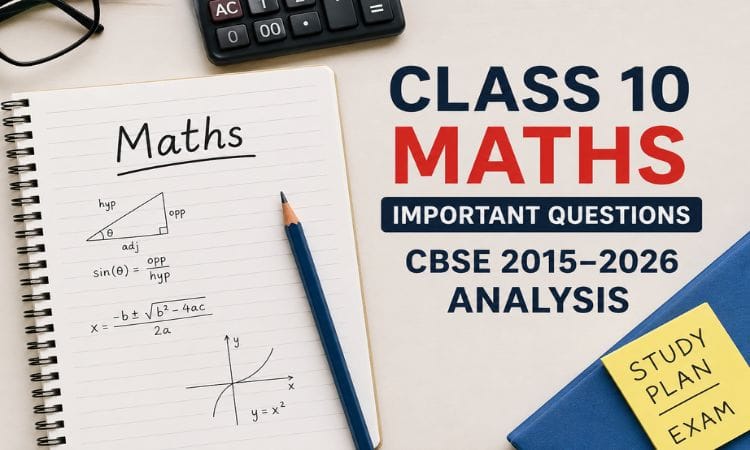
Actually, a careful analysis of CBSE Class 10 Maths papers over the past decades shows a strong pattern. The board is consistently rotating the same core concepts, mostly presenting them with slight variations in values or wording. It implies that preparation can be really far more focused than most students assume.
Rather than solving endless questions, just keep on the ones that appear again and again. This is because CBSE mostly relates problem types from Algebra, Trigonometry, Geometry, along with Mensuration. These are not random indeed. They actually follow a clear pattern.
In this blog, we’ve brought together a chapter-wise selection of such repeatedly asked questions from 2015 to 2026, along with valuable insights based on actual trends of exams, so that your preparation stays precise, relevant, and exam-oriented.
Why Solving Repeated Questions is the Smartest Strategy for Class 10 Maths
CBSE Maths papers follow a pattern. The concepts remain the same, only the presentation changes. This is why the questions of the previous year, class 10 maths is not merely a practice, but a direct outlook of the setting of the paper.
Concentrating on similar questions is beneficial since:
- You are aware of the types of questions that are more likely to be found very fast.
- Your style becomes focused and organized.
- The possibility of errors is minimized.
- The pace is enhanced by examination pressure.
This is what contributes to it being a good CBSE maths preparation plan. You are not making a judgment about what could come and what could not, but you are making a judgment about what actually will come, and what will not come again and again, directly improving your score.
CBSE Class 10 Maths Paper Analysis (2015–2026 Trends)
An analysis of a close CBSE maths paper analysis class 10 in the last decade reveals a stable structure with predictable areas of scoring. The board has ensured to balance the paper across significant chapters and slowly shift the focus towards application.
Chapter Weightage Trends (Observed Pattern)
- Algebra: Occurs annually with 2-3 questions, and is frequently substantial in nature.
- Trigonometry: Identities and Heights & Distances are repeated frequently
- Geometry: Triangles and circles. Regular questions, particularly proofs.
- Mensuration: Problems of surface areas and volumes are presented in the form of applications.
- Statistics & Probability: Almost always included, generally scoring
Difficulty Level Analysis
- Approximately 60-70 percent of the paper is moderate to easy.
- Questions 2030 percent test greater depth of knowledge, predominantly of Geometry and Algebra.
- A little part is developed to distinguish the best scorers.
CBSE Exam Pattern Maths Trend Shift in CBSE Exam Pattern Maths 2026.
- Evident rise in competency-based and case-study questions.
- Application and reasoning, rather than formulae, are now tested by questions.
- The same ideas are used over and over again, except that new methods of presentation are used.
It is evident in the analysis that although the format is changing the main topics and question patterns are similar. With these trends, students who get ready according to these trends are able to approach the exam with greater clarity and control.
Chapter-Wise Most Repeated Maths Questions Class 10 (With Solutions)
Algebra – Most Repeated Questions
Common topics:
- Linear equations
- Quadratic equations
- Polynomials
Example Questions:
- Solve: 2x² – 5x – 3 = 0
- Find zeroes of a polynomial
- Solve pair of linear equations graphically
Tip: Practice step-by-step solving
Trigonometry – Most Repeated Questions
Common topics:
- Trigonometric identities
- Heights & distances
Example Questions:
- Prove: sin²A + cos²A = 1
- Find height using angle of elevation
- Evaluate trigonometric expressions
Tip: Learn all formulas properly
Geometry – Most Repeated Questions
Common topics:
- Theorems
- Proof-based questions
Example Questions:
- Prove triangle similarity
- Find area using theorem
- Tangent properties questions
Tip: Practice diagrams clearly
Mensuration – Most Repeated Questions
Common topics:
- Surface area & volume
Example Questions:
- Find volume of cylinder/cone
- Water tank word problems
- Combination of solids
Tip: Focus on formulas
Statistics & Probability – Most Repeated Questions
Common topics:
- Mean, median, mode
- Basic probability
Example Questions:
- Find mean using formula
- Calculate probability of event
- Construct cumulative frequency
Tip: Easy scoring chapter
Top 20 Most Repeated Maths Questions (2015–2026)
Algebra
- Solve the quadratic equation:
2x² – 5x – 3 = 0 - Find the zeroes of the polynomial and verify the relationship between zeroes and coefficients.
- Solve the pair of linear equations using substitution or elimination method.
- Draw the graph of the pair of linear equations and find the point of intersection.
Trigonometry
- Prove the identity:
sin²A + cos²A = 1 - Evaluate:
(sin 30° + cos 60°) / (tan 45°) - A tower stands on a horizontal ground. The angle of elevation of the top from a point on the ground is 30°. Find the height of the tower if the point is 20 m away from the base.
Geometry
- Prove that two triangles are similar using AA similarity criterion.
- In two similar triangles, find the ratio of their areas if the ratio of their corresponding sides is given.
- Prove that the tangent at any point of a circle is perpendicular to the radius through the point of contact.
- In a cyclic quadrilateral, prove that the sum of opposite angles is 180°.
Mensuration
- Find the total surface area of a cylinder with given radius and height.
- A solid is a combination of a cone and a cylinder. Find its volume.
- A water tank is in the shape of a cuboid. Find the capacity of the tank in litres.
Statistics
- Find the mean of the given data using the assumed mean method.
- Find the median of the given grouped data.
- Draw the cumulative frequency curve (ogive) and find the median.
Probability
- Find the probability of getting a head when a coin is tossed.
- Find the probability of drawing a red card from a deck of 52 playing cards.
Case-Based
- Read the given case study and answer the questions based on real-life application of linear equations / trigonometry.
Free PDF Download – Class 10 Maths Important Questions
To help you prepare faster, we have created a FREE PDF with:
- Chapter-wise important questions
- Most repeated questions (2015–2026)
- Easy-to-understand solutions
How to Use These Questions to Score 90+ in Maths
Passing questions will not give marks. The distinction is based on the way you practice and revise. When you are in the process of learning how to obtain a score of 90 in Maths class 10, you require a clear and stepwise approach, which you can constantly follow.
Step 1: Daily Practice Plan
Read one chapter at a time and concentrate on the worst and recurring questions. Rather than rushing through numerous problems, find approximately 8 to 10 questions that you are going to fully concentrate on. Put down each step correctly, as CBSE not only gives marks on the final answer but also on the method. Finish your practice by a few mixed questions to keep your concepts related.
Step 2: Structured Revision
The revision to take place should not be random. After two to three days, go back to the same questions and later go back after a week and repeat the same questions. This practice will aid in remembering the technique vividly. With time, you will realize that you require a shorter time to answer the same question, and this is what you need in exams.
Step 3: Mistake Analysis Method
This is the step that actually makes your marks better. Make a separate notebook in which you list the questions on which you got a low score, and why. It may be a conceptual error, an error in calculation, or omission of an action. By asking these questions, you will not make the same mistakes, and you will become more accurate on your own.
Step 4: Timed Practice
When you feel at ease with the concepts, begin to answer questions within a given time frame. This develops momentum, and it assists you in coping with stress when taking the exam. You also get to know how long to take on each question, which is a significant aspect of a successful maths study plan.
Common Mistakes Students Make in Maths Preparation
Avoid these mistakes:
- Ignoring NCERT examples
- Memorizing without understanding
- Not practicing diagrams
- Skipping previous year papers
- Avoiding difficult chapters
Final Thoughts
Practicing the most repeated maths questions in CBSE Class 10 board exams is one of the smartest ways to improve marks. The analysis of previous papers from 2015–2026 clearly shows that CBSE follows important patterns and frequently repeats concepts.
Students who regularly solve:
- Previous year questions
- NCERT exercises
- Important formula-based problems
usually score much higher in board exams.
Instead of studying everything randomly, focus on high-frequency question types and smart revision.
FAQs
Are CBSE maths questions repeated every year?
CBSE may not repeat the exact same question every year, but similar concepts and patterns are frequently repeated.
Which chapter is most important in Class 10 Maths?
Algebra and Trigonometry are considered the most important chapters because they carry high weightage.
Is NCERT enough for CBSE Maths board exams?
NCERT is the most important resource, but students should also practice previous year questions and sample papers.
How many previous year papers should students solve?
Students should solve at least the last 5–10 years’ board papers for better preparation.
Are competency-based questions important for CBSE 2026?
Yes, CBSE now includes more competency-based and application-oriented questions in board exams.