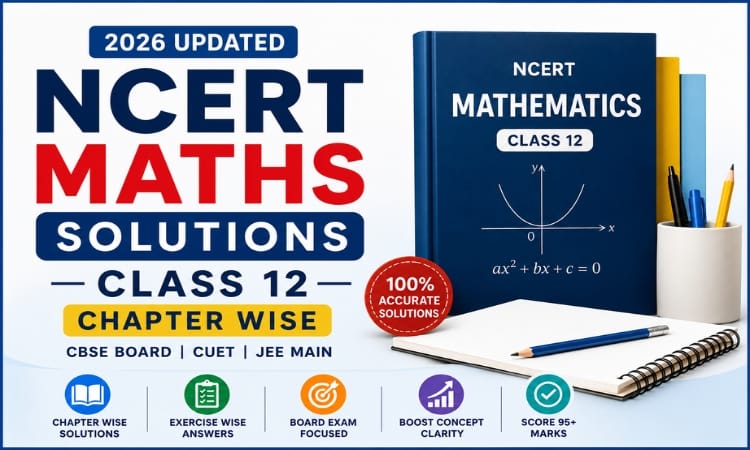
NCERT books are the foundation of class 12 Maths. They cover the whole syllabus, discuss the concepts in detail and improve problem-solving skills.
Studying NCERT Maths Solutions Class 12 Chapter Wise helps you with the CBSE board exams and also in CUET & JEE Main-like exams.
But how to use NCERT Maths books to score high marks and pass competitive exams? In this blog, we will discuss that.
Quick Access to NCERT Maths Solutions Class 12 Chapter-Wise:
| 📖 Chapter | 📄 Download PDF |
|---|---|
| Chapter 1: Relations and Functions | 🔵 Download PDF |
| Chapter 2: Inverse Trigonometric Functions | 🔵 Download PDF |
| Chapter 3: Matrices | 🔵 Download PDF |
| Chapter 4: Determinants | 🔵 Download PDF |
| Chapter 5: Continuity and Differentiability | 🔵 Download PDF |
| Chapter 6: Applications of Derivatives | 🔵 Download PDF |
| Chapter 7: Integrals | 🔵 Download PDF |
| Chapter 8: Applications of Integrals | 🔵 Download PDF |
| Chapter 9: Differential Equations | 🔵 Download PDF |
| Chapter 10: Vector Algebra | 🔵 Download PDF |
| Chapter 11: Three-Dimensional Geometry | 🔵 Download PDF |
| Chapter 12: Linear Programming | 🔵 Download PDF |
| Chapter 13: Probability | 🔵 Download PDF |
NCERT Maths Solutions Class 12: Chapter-Wise Overview:
Chapter 1: Relations and Functions
What You Will Learn: Domain, range, relations, functions, and types of functions.
Important Concepts: One-to-one and onto functions, composition of functions.
Board Exam Relevance: Medium to high.
Difficulty Level: Moderate
Chapter 2: Inverse Trigonometric Functions
What You Will Learn: Inverse trigonometric functions, principal values, domains, and ranges.
Important Concepts: Properties of inverse trigonometric functions, identities, and simplification techniques.
Board Exam Relevance: Medium.
Difficulty Level: Moderate.
Chapter 3: Matrices
What You Will Learn: Matrix operations, order of matrices, matrix algebra, transpose, and inverse of matrices.
Important Concepts: Matrix multiplication, identity matrix, symmetric and skew-symmetric matrices.
Board Exam Relevance: High.
Difficulty Level: Easy
Chapter 4: Determinants
What You Will Learn: Determinants, minors, cofactors, properties of determinants, and matrix solutions.
Important Concepts: Expansion of determinants, area of triangles, inverse of matrices using determinants.
Board Exam Relevance: High.
Difficulty Level: Moderate.
Chapter 5: Continuity and Differentiability
What You Will Learn: Continuity, differentiability, derivatives of functions, and chain rule applications.
Important Concepts: Continuity conditions, exponential and logarithmic differentiation, derivatives of inverse trigonometric functions.
Board Exam Relevance: Very High.
Difficulty Level: Moderate
Chapter 6: Applications of Derivatives
What You Will Learn: Increasing and decreasing functions, maxima-minima, tangents, normals, and rate of change.
Important Concepts: Monotonicity, optimisation problems, approximation, and curve analysis.
Board Exam Relevance: Very High.
Difficulty Level: Moderate
Chapter 7: Integrals
What You Will Learn: Indefinite integrals, definite integrals, integration methods, and properties of integration.
Important Concepts: Substitution method, integration by parts, partial fractions, and standard integrals.
Board Exam Relevance: Very High.
Difficulty Level: Difficult.
Chapter 8: Applications of Integrals
What You Will Learn: Applications of definite integrals for finding areas under curves and between curves.
Important Concepts: Area bounded by curves, graphical interpretation of integration.
Board Exam Relevance: High.
Difficulty Level: Moderate.
Chapter 9: Differential Equations
What You Will Learn: Formation and solution of differential equations using standard methods.
Important Concepts: Variable separable method, homogeneous equations, and real-life applications.
Board Exam Relevance: High.
Difficulty Level: Moderate
Chapter 10: Vector Algebra
What You Will Learn: Vector operations, vector products, scalar products, and geometric applications.
Important Concepts: Dot product, cross product, unit vectors, and vector magnitude.
Board Exam Relevance: High.
Difficulty Level: Easy
Chapter 11: Three-Dimensional Geometry
What You Will Learn: Direction cosines, direction ratios, equations of lines, planes, and shortest distance concepts.
Important Concepts: Vector equations, Cartesian equations, angle between lines and planes.
Board Exam Relevance: High.
Difficulty Level: Moderate
Chapter 12: Linear Programming
What You Will Learn: Optimisation problems, feasible regions, and graphical methods of solving equations.
Important Concepts: Constraints, objective functions, and maximising or minimising values.
Board Exam Relevance: Medium
Difficulty Level: Easy.
Chapter 13: Probability
What You Will Learn: Conditional probability, independent events, Bayes’ theorem, and random variables.
Important Concepts: Multiplication theorem, total probability theorem, and probability distributions.
Board Exam Relevance: Very High
Difficulty Level: Moderate.
Why Exercise-Wise NCERT Solutions Matter
- Helps identify mistakes quickly
- Improves conceptual understanding
- Builds confidence for board exams
- Makes revision more effective
Common Mistakes Students Make
- Copying solutions without attempting questions
- Ignoring NCERT examples
- Skipping difficult exercises
- Not revising formulas regularly
Class 12 Maths Chapter-Wise Weightage
| Unit | Chapters Included | Approx. Weightage (Marks) |
|---|---|---|
| Algebra | Relations & Functions, Inverse Trigonometric Functions, Matrices, Determinants | 10–12 |
| Calculus | Continuity & Differentiability, Applications of Derivatives, Integrals, Applications of Integrals, Differential Equations | 35–40 |
| Vectors & 3D Geometry | Vector Algebra, Three-Dimensional Geometry | 14–17 |
| Linear Programming | Linear Programming | 5 |
| Probability | Probability | 8–10 |
Chapters Carrying Maximum Marks
- Integrals
- Applications of Derivatives
- Probability
- Differential Equations
- Matrices and Determinants
Easier Scoring Chapters
- Linear Programming
- Matrices
- Determinants
- Relations and Functions
Most Important Chapters in Class 12 Maths:
High Weightage Chapters
- Integrals
- Applications of Derivatives
- Probability
- Differential Equations
High Scoring Chapters
- Matrices
- Determinants
- Linear Programming
Chapters Requiring Extra Practice
- Continuity and Differentiability
- Differential Equations
- Three-Dimensional Geometry
Class 12 Maths Formula Sheet (Quick Revision)
Algebra Formulas
- Matrix Multiplication Rules
- Determinant Properties
Calculus Formulas
- Differentiation Rules
- Integration Formulas
Vector Algebra Formulas
- Dot Product Formula
- Cross Product Formula
Three-Dimensional Geometry Formulas
- Distance Formula
- Equation of Line
Probability Formulas
- Conditional Probability
- Bayes Theorem
How to Score 95+ Marks in Class 12 Maths?
- Complete NCERT Examples, concepts.
- Solve Every Exercise Question to build speed and accuracy.
- Create a formula notebook and revise Formulas Weekly.
- Practice Previous Year Papers to identify trends and time management.
- Focus on Weak Chapters.
30-Day Class 12 Maths Study Plan:
| Week | Focus Area |
|---|---|
| Week 1 | Relations, Functions, Matrices, Determinants |
| Week 2 | Continuity, Differentiability, Applications of Derivatives |
| Week 3 | Integrals, Applications of Integrals, Differential Equations |
| Week 4 | Probability, Vectors, 3D Geometry and Full Revision |
Is NCERT Enough for the Class 12 Maths Board Exam?
For CBSE Boards
Yes. NCERT covers almost all board exam questions directly or indirectly.
For CUET
NCERT is the primary source and should be completed thoroughly.
For JEE Main
NCERT builds strong fundamentals, but additional practice from reference books is recommended.
When Additional Books Are Needed
- JEE Main Preparation
- JEE Advanced Preparation
- Olympiads
- Advanced Competitive Exams
Benefits of Using NCERT CBSE Class 12 Maths Solutions:
- Better concept clarity
- Faster revision
- Improved accuracy
- Strong foundation for competitive exams
- More confidence in board exams
FAQs:
Are NCERT Maths solutions enough for Boards?
Yes, NCERT is sufficient for scoring excellent marks in CBSE board exams.
Which chapter has the highest weightage in Class 12 Maths?
Integrals and Applications of Derivatives generally carry the highest weightage.
Which chapter is the toughest in Class 12 Maths?
Many students find Integrals and Differential Equations challenging.
Can I score 100/100 using NCERT?
Yes, many students achieve full marks by thoroughly completing NCERT and previous year papers.
How many times should I revise NCERT Maths?
At least three complete revisions are recommended.
Is NCERT enough for JEE Main Maths?
NCERT is essential but not sufficient alone for top JEE Main scores.
Conclusion
NCERT Maths Solutions Class 12 Chapter Wise provide a structured approach to mastering Mathematics for CBSE Board Exams, CUET, and JEE Main. Students should focus on understanding concepts instead of memorizing answers and complete every chapter systematically. Regular practice, formula revision, and consistent use of chapter-wise solutions can significantly improve accuracy and confidence, helping students achieve excellent scores in Class 12 Mathematics.